Table of Contents
What’s stopping your eCommerce brand from scaling faster: demand or logistics? Many growing brands focus on marketing and sales, only to realise that warehousing and fulfilment are the real bottlenecks. As order volume increases, managing inventory, packing, shipping, and returns becomes a complex, costly challenge.
Scaling an eCommerce business isn’t just about selling more; it’s about delivering efficiently at every stage. This is where 3PL warehousing comes in. By outsourcing storage, inventory management, and order fulfilment to a third-party logistics partner, brands streamline operations, reduce overhead, and focus on growth-driving activities.
The importance of efficient warehousing is reflected in the rapid growth of India’s logistics infrastructure. The Indian warehouse market was valued at ₹1,636 billion in 2025 and is expected to reach ₹3,370.55 billion by 2034, growing at a CAGR of 8.36%. As eCommerce expands and delivery expectations rise, more brands are turning to 3PL warehousing solutions to handle storage, fulfilment, and distribution efficiently.
In this blog, we’ll explore how 3PL warehousing supports faster expansion, improves operational efficiency, and helps eCommerce brands scale without being held back by logistics limitations.
What is 3PL Warehousing?
3PL warehousing refers to outsourcing your storage, inventory management, and order fulfilment operations to a third-party logistics provider. Instead of managing your own warehouse, staff, and shipping processes, you partner with a logistics company that handles these operations on your behalf.
A 3PL provider stores your products in its warehouse facilities, manages inventory levels, processes incoming orders, picks and packs items, and ships them directly to your customers. Many 3PL companies also handle returns, inventory tracking, and value-added services such as labelling and custom packaging.
For eCommerce brands, 3PL warehousing eliminates the need to invest heavily in infrastructure, technology, and manpower. It allows businesses to access established logistics networks and advanced fulfilment systems without building everything from scratch. This makes operations more efficient, scalable, and cost-effective, especially for growing brands looking to expand quickly.
Benefits of 3PL Warehousing for eCommerce Brands
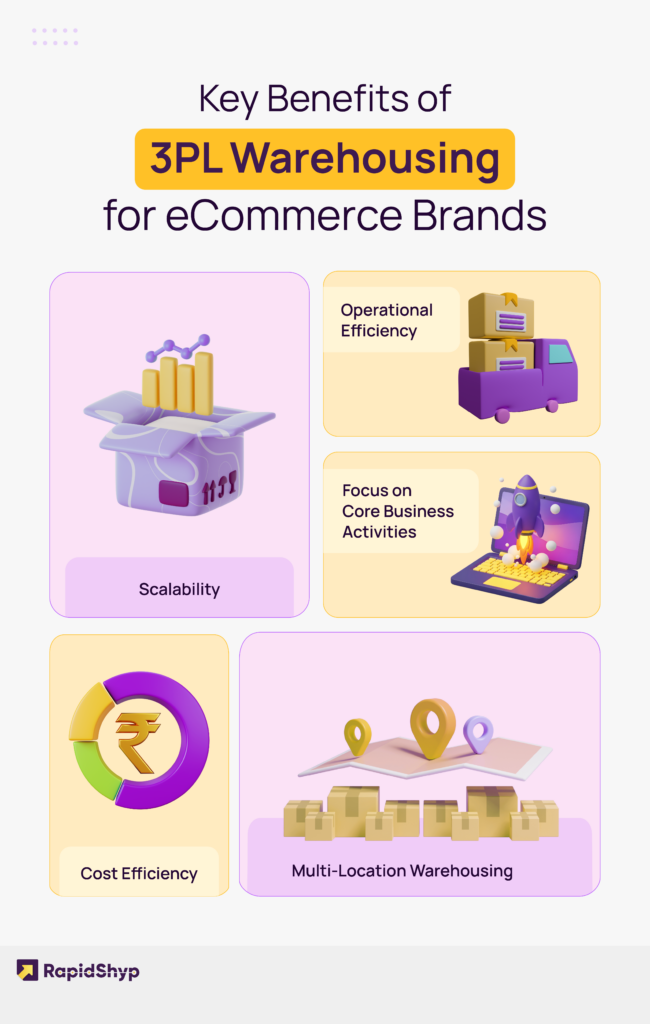
As eCommerce brands grow, logistics becomes more complex. Managing inventory, handling bulk orders, ensuring timely deliveries, and processing returns quickly consume time and resources. Here, 3PL warehousing offers significant advantages.
Scalability
One of the biggest advantages of 3PL warehousing is scalability. As your eCommerce business grows, order volumes can fluctuate with seasonal demand, festive sales, product launches, or marketing campaigns. Managing these variations internally is challenging and expensive. A 3PL partner lets you scale storage space, workforce, and fulfilment capacity up or down based on demand. This flexibility keeps your operations running smoothly during peak periods without long-term investments in extra infrastructure.
Cost Efficiency
Operating your own warehouse involves high fixed costs, including rent, utilities, equipment, technology systems, and labour. With a 3PL provider, these expenses are shared across multiple clients, making logistics more affordable and predictable. Instead of investing in warehouse infrastructure, businesses pay only for the space and services they use. This turns fixed costs into variable costs, improving cash flow and letting brands allocate resources to growth-focused activities.
Operational Efficiency
3PL providers specialise in logistics and fulfilment, with established processes, trained staff, and advanced technology systems. From inventory management and order processing to picking, packing, and shipping, their streamlined operations reduce errors and improve delivery speed. Real-time tracking and automated systems enhance accuracy and transparency, ensuring customers receive the right products on time. This operational efficiency can significantly improve customer satisfaction and brand reputation.
Focus on Core Business Activities
Managing warehousing and fulfilment internally can consume significant time and attention. By outsourcing logistics to a 3PL partner, eCommerce brands can focus on what drives growth: marketing, product development, customer acquisition, and brand building. Instead of handling daily operational challenges, teams can concentrate on strategic initiatives that increase revenue and strengthen market presence.
Multi-Location Warehousing
Many 3PL providers offer access to multiple warehouse locations across different cities or regions. This lets brands store inventory closer to customers, reducing shipping time and delivery costs. Faster deliveries enhance customer satisfaction and improve competitiveness in markets where quick shipping is expected. Multi-location warehousing also reduces dependency on a single fulfilment centre, minimising risks and ensuring smoother nationwide or regional expansion.
Overall, 3PL warehousing helps eCommerce brands operate more efficiently, reduce risks, and scale faster without logistics limitations.
Why eCommerce Brands Struggle to Scale Without 3PL
Scaling an eCommerce brand sounds exciting until operations fall behind. Many businesses experience rapid order growth but struggle to manage the pressure on warehousing, fulfilment, and shipping. Without a structured logistics system, growth can quickly turn into chaos.
Limited Warehouse Capacity
As eCommerce brands grow, inventory levels increase to meet rising demand. Without adequate warehouse space, businesses often face overcrowded storage, poor inventory organisation, and delayed order processing. Expanding warehouse infrastructure requires significant capital investment, long-term leases, and more manpower. For many growing brands, limited storage capacity becomes a major barrier to smooth scaling.
Operational Inefficiency
Managing warehousing and fulfilment internally can lead to inefficiencies, especially as order volumes rise. Manual inventory tracking, unstructured picking and packing, and coordination challenges with courier partners increase the risk of errors and delays. Even small mistakes, such as incorrect shipments or stock mismanagement, can hurt customer satisfaction and brand credibility. As complexity increases, maintaining speed and accuracy becomes more difficult without specialised logistics systems.
Rising Logistics Costs
Handling logistics independently often results in high fixed costs, including warehouse rent, utilities, equipment, packaging, staff salaries, and shipping coordination. As order volumes grow, these expenses increase, but without economies of scale, profit margins can shrink. Managing multiple courier partnerships and reverse logistics adds more financial pressure. Rising logistics costs can slow profitability and limit reinvestment into growth strategies.
Seasonal Demand Spikes
Festive sales, promotional campaigns, and product launches often bring sudden surges in orders. Without scalable infrastructure, internal teams may struggle to handle the increased workload. This can lead to shipment delays, fulfilment errors, and overwhelmed staff. Seasonal demand spikes expose the limits of in-house logistics, making it hard for brands to maintain consistent service during peak periods.
Managing logistics internally takes focus away from core growth activities. Instead of investing time in marketing, product development, and customer acquisition, founders and teams get caught up in operations. Without a 3PL partner, scaling is slower, more expensive, and riskier. To grow sustainably, eCommerce brands need a logistics framework that supports expansion without losing momentum.
Who Should Consider 3PL Warehousing?
3PL warehousing is not just for large enterprises; it is a strategic solution for eCommerce brands at various stages of growth. If logistics become overwhelming or operational challenges slow expansion, partnering with a 3PL provider can be a smart move.
Growing D2C Brands
Direct-to-consumer (D2C) brands with consistent order growth should consider 3PL warehousing early. As sales increase, managing storage, order fulfilment, and returns internally can quickly become inefficient. Limited infrastructure and manpower may lead to delays, fulfilment errors, and bottlenecks. A 3PL partner brings structured processes, technology, and scalable capacity, allowing D2C brands to maintain service quality while focusing on marketing, customer engagement, and product innovation.
Brands Expanding to New Cities or Regions
When eCommerce brands expand into new markets, logistics becomes more complex. Delivering orders across regions from a single warehouse often increases shipping costs and delivery times. A 3PL provider with multi-location warehousing enables brands to store inventory closer to customers, ensuring faster deliveries and better customer satisfaction. This makes expansion smoother without heavy investments in new facilities.
Businesses Facing Seasonal Demand Spikes
Festive seasons, flash sales, and promotional campaigns often bring sudden increases in order volumes. Without scalable logistics, internal teams may struggle to manage these spikes, leading to delayed shipments and fulfilment errors. 3PL warehousing offers the flexibility to scale storage capacity and workforce as demand fluctuates, ensuring consistent service even during peak periods.
Startups and Small Businesses
Startups and small eCommerce businesses looking to minimise initial investments in warehouse space, technology, and manpower can benefit from 3PL warehousing. Instead of committing to high fixed costs, they can adopt a variable cost model and pay only for the storage and fulfilment services they use. This flexibility helps young brands grow sustainably while keeping operational risks low.
Brands Offering Same-Day & Next-Day Delivery
As customer expectations for faster delivery rise, many eCommerce brands strive to offer same-day or next-day delivery. Achieving this speed requires strategically located warehouses, efficient inventory management, and streamlined fulfilment operations.
This expectation is becoming more important as over 80% of shoppers prefer same-day shipping, and next-day delivery is now normal in eCommerce. A 3PL partner with a distributed warehouse network lets brands store inventory closer to customers, enabling faster deliveries without building and managing multiple fulfilment centres.
By leveraging 3PL infrastructure, brands can meet rising delivery expectations while avoiding the heavy investments required to build their own logistics network. Ultimately, any eCommerce brand that wants to focus on marketing, customer experience, and product innovation rather than warehouse management should consider 3PL warehousing as a key enabler of scalable growth.
Read More: Importance of Same Day & Next Day Delivery for eCommerce
Signs: It’s Time to Switch to 3PL
As your eCommerce business grows, logistics can quietly become the biggest roadblock to scaling. If you’re unsure whether it’s time to partner with a 3PL provider, certain warning signs can make the answer clear.
One major sign is frequent order delays or fulfilment errors. If shipments go out late, incorrect items are delivered, or returns increase because of packing mistakes, your internal operations may be stretched beyond capacity. Another clear indicator is running out of storage space. If inventory piles up in small warehouses, offices, or your home, it signals that your current setup cannot support growth. Expanding space independently requires heavy investment and planning.
Rising logistics and manpower costs are also a red flag. If you spend more time and money hiring staff, managing courier partners, and handling warehouse operations than growing your brand, logistics may be draining your resources. Struggling during seasonal sales or demand spikes is another strong sign. If your team feels overwhelmed during festive seasons, or if product launches or promotions result in delivery timelines suffering, you likely need a scalable logistics solution.
Finally, if you focus more on packing boxes than on marketing, strategy, or product innovation, it may be time to outsource. When logistics limits growth instead of supporting it, switching to a 3PL partner becomes a strategic move rather than just an operational decision.
Recognising these signs early helps you scale smoothly without compromising customer experience or profitability.
How to Choose the Right 3PL Partner
Choosing the right 3PL partner is a strategic decision that affects your customer experience, operational efficiency, and ability to scale. Before finalising a provider, evaluate these key factors to ensure the partnership supports your business growth.
Warehouse Network and Geographic Coverage
Assess the provider’s warehouse network and location coverage. A strong 3PL should have fulfilment centres in major regions to keep inventory closer to customers. This reduces shipping distances, lowers delivery costs, and improves delivery speed.
Technology and System Integration
Ensure the 3PL offers seamless integration with your eCommerce platform. Features such as real-time inventory tracking, automated order processing, and transparent reporting provide better visibility and help maintain operational efficiency.
Operational Performance
Review the provider’s performance metrics, including order accuracy, processing speed, and returns management. A reliable 3PL should consistently handle orders efficiently while minimising fulfilment errors.
Scalability and Capacity
Your logistics partner should scale operations as your business grows. During festive seasons, promotional sales, or sudden demand spikes, the 3PL must handle increased order volumes without affecting service quality.
Pricing Transparency
Examine the pricing structure to ensure there are no hidden charges. Transparent pricing helps businesses manage logistics budgets effectively and maintain predictable operational costs.
Communication and Support
Strong communication and responsive support are essential for smooth daily operations. A dependable 3PL partner should provide timely updates, quick issue resolution, and clear coordination with your team.
Long-Term Partnership Potential
The right 3PL should act as a long-term logistics partner, not just a service provider. A reliable partner strengthens your supply chain foundation and supports sustainable business growth as you scale.
How RapidShyp Warehousing Helps eCommerce Brands Scale Faster
Scaling an eCommerce brand requires more than increasing sales; it demands a logistics system that can handle growth without slowing operations. RapidShyp Warehousing supports brands at every stage of expansion with streamlined storage, efficient fulfilment, and technology-driven inventory management.
With strategically located warehouses, RapidShyp enables brands to store inventory closer to customers, reducing delivery timelines and shipping costs. Faster fulfilment improves customer satisfaction and strengthens brand credibility. Its advanced technology integration allows real-time inventory tracking, seamless order processing, and accurate reporting for complete visibility and operational control.
RapidShyp helps brands stay prepared for demand spikes during festive seasons, flash sales, and product launches. Instead of worrying about storage space or manpower limitations, businesses scale operations smoothly through a flexible warehousing network. By handling pick, pack, ship, and return management efficiently, RapidShyp lets brands focus on marketing, product innovation, and customer engagement.
Scaling eCommerce Without Logistics Limitations
Scaling an eCommerce brand is not just about driving more traffic or increasing sales. It is about building an operational backbone that supports consistent growth. Without the right logistics structure, rising order volumes quickly lead to delays, higher costs, and dissatisfied customers. This is where 3PL warehousing becomes a strategic advantage rather than just an operational choice.
By partnering with the right 3PL provider, brands gain access to scalable infrastructure, advanced technology, and efficient fulfilment processes without heavy upfront investments. This helps businesses stay agile during demand spikes, reduce logistics complexity, and focus on what drives growth: marketing, customer experience, and product innovation.
Ultimately, 3PL warehousing empowers eCommerce brands to grow confidently, expand into new markets, and deliver better customer experiences, all while keeping operations streamlined and sustainable.
FAQs
What does 3PL warehousing mean?
3PL (Third-Party Logistics) warehousing means outsourcing storage, inventory management, order fulfilment, and shipping to a specialised logistics provider rather than managing them in-house.
How does 3PL warehousing help eCommerce brands scale?
3PL providers offer scalable storage, advanced fulfilment systems, and established courier networks. This lets brands handle higher order volumes, expand to new locations, and manage seasonal spikes without heavy investment in infrastructure.
Is 3PL warehousing suitable for small eCommerce businesses?
Yes. Startups and growing brands benefit from 3PL services because they reduce upfront investment in warehouses, staff, and technology. This converts fixed operational costs into flexible, usage-based expenses.
Can a 3PL provider handle returns and reverse logistics?
Most professional 3PL providers manage returns, exchanges, and reverse logistics. This improves efficiency, reduces processing time, and ensures a smooth customer experience.
When should a brand switch to a 3PL partner?
Brands should consider switching to a 3PL when order volumes increase, warehouse space is limited, fulfilment errors rise, logistics costs grow, or internal operations slow overall business growth.


Calculate Your Shipping Rates

| Courier Partner | Mode | Chargeable Weight (KG) | Shipping Rates |
|---|