Table of Contents
When anyone discusses ecommerce growth, they usually focus on scaling sales and marketing. Often ignored, transit damage quietly cuts into margins and slowly causes customers to lose confidence in your brand.
No brand plans for damaged shipments, yet almost every growing business faces it at some point. A product leaves the warehouse in perfect condition, but by the time it reaches the customer, the packaging is crushed, wet, or torn. And in that moment, all the effort invested in sourcing, marketing, and selling feels wasted.
Shipping damage isn’t only a financial loss; it’s a brand loss. Delays are forgivable; damaged deliveries aren’t.
The truth is, transit damage can’t be completely avoided. Packages move through multiple hands, vehicles, and warehouses. However, with the right preventive steps, the risk can be significantly reduced.
Here are the Top 7 ways to prevent transit damage that help to protect your products and your brand credibility.
Choose the Right Packaging Size for Every Shipment
Oversized packaging is one of the most common shipping mistakes. When a product is packed in a box much larger than required, it moves freely during transit. This internal movement increases the risk of dents, scratches, and breakage, even with cushioning.
The ideal package should fit the product closely, leaving only enough space for protective cushioning. Extra space does not add safety; it creates instability. Right-sized packaging also improves stacking efficiency, reduces volumetric weight charges, and minimises movement-related damage.
Seal Packages Securely with High-Quality Materials
A well-packed product can still get damaged if it’s poorly sealed. Weak tape, incomplete seam coverage, or low-grade materials increase the risk of opening mid-transit. Packages are lifted, stacked, slid and sometimes dropped. Sealing must withstand real-world logistics conditions, not just warehouse handling.
Using strong pressure-sensitive packaging tape, reinforced seams, and proper edge and corner sealing ensures structural integrity and prevents exposure to impact, moisture, and tampering.
Use Proper Cushioning to Fill Empty Spaces
Empty space inside a box is one of the biggest contributors to transit damage. When products aren’t immobilised, they collide with the box walls during transport.
Each product should be wrapped individually and surrounded by cushioning on all sides. Materials such as bubble wrap, foam inserts, air pillows, and crinkled paper absorb shock and vibration.
A quick test helps identify risk: gently shake the sealed box. If you feel movement, the cushioning needs improvement.
Test and Validate Your Packaging Materials
There is no universal packaging solution that works for every product. Fragile items, electronics, liquids, and heavy goods behave differently during transit. What works for one product may fail for another.
Packaging should be tested under real-world conditions such as drop impact, compression pressure, vibration, and stacking weight. Testing helps identify weaknesses before they lead to large-scale losses.
Prevention at the testing stage saves far more than reactive replacement later.
Ensure Clear and Correct Labelling
Once a shipment leaves your facility, you lose direct control over handling. Clear labelling helps reduce unnecessary mishandling.
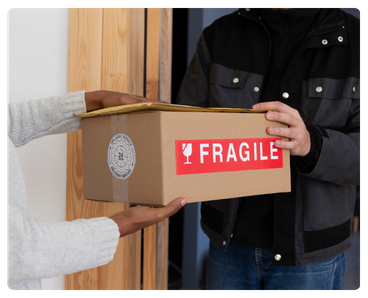
Labels such as Fragile, Handle With Care, and This Side Up help reduce avoidable mishandling. Orientation labels are especially important for liquids, electronics, and sensitive equipment. Accurate labelling also improves scanning efficiency and reduces sorting errors, which can lead to improper stacking.
Good labelling doesn’t guarantee perfect handling, but it significantly reduces unnecessary risk.
Read More: The Best Way to Attach Shipping Labels
Choose Couriers Based on Product Requirements
Not all courier networks are designed for all product types. Some handle fragile shipments better; others are optimised for bulk or heavy shipments. Some prioritise last-mile efficiency.
Choosing a courier based on cost often increases damage risk due to longer routes, excessive hub transfers, and unsuitable handling processes. Matching courier capability to product requirements reduces touchpoints and improves overall delivery safety.
Invest in Shipment Security Strategically
Despite best efforts, unforeseen damage can still occur. Shipping insurance acts as a financial safety net. However, insuring every shipment blindly increases operational costs. Brands should take a strategic approach, focusing on high-value products, fragile goods, and insure shipments with higher loss probability.
Insurance doesn’t replace prevention, yet complements it.
How RapidShyp Fixes Transit Damage Challenges
Preventing transit damage isn’t just about adding extra layers of packaging. It’s about building a smarter shipping ecosystem. Damage can occur at multiple stages, from warehouse handling and sorting to vehicle loading and last-mile delivery. Without proper systems, even strong packaging may fail due to inefficient routing or unsuitable courier selection. This is where RapidShyp plays a critical role.
Smart Courier Selection
RapidShyp enables brands to select courier partners based on product sensitivity, delivery location, performance data, and service reliability rather than assumptions. Matching fragile, high-value, or time-sensitive shipments to the most suitable delivery networks reduces the chances of mishandling, delays, and transit-related damage. This strategic allocation ensures that each shipment moves through a courier system best equipped to handle its specific requirements.
Reduced Transit Touchpoints
Excessive handling is one of the primary causes of transit damage. RapidShyp optimises routing and courier allocation to limit unnecessary transfers between hubs and delivery partners. By reducing handovers and streamlining the shipment journey, it minimises physical stress on packages, significantly lowering the risk of impact damage, crushing, or internal product movement.
Data-Driven Decision Making
With clear visibility into shipment performance, RapidShyp empowers sellers to make informed decisions backed by real data. Brands can identify recurring patterns in damage rates, delivery delays, or courier inefficiencies and proactively take corrective action. This analytical approach transforms shipping from a reactive process into a continuously improving system that reduces risk and enhances reliability.
Centralised Shipping Control
Managing all shipments through a single platform allows brands to standardise packaging methods, labelling practices, and courier selection criteria. This centralised control eliminates inconsistencies that often lead to operational errors or damaged goods. It ensures that every order follows the same structured process, maintaining uniform quality across all deliveries.
Scalable, Seller-Friendly Operations
As businesses grow and order volumes increase, operational complexity often rises along with the risk of shipping errors and damage. RapidShyp provides a scalable infrastructure that supports expansion without compromising efficiency or safety. Maintaining structured processes and performance monitoring at scale, it enables brands to grow confidently while keeping damage rates under control and operations streamlined.
Conclusion
Transit damage isn’t just a logistics issue; it’s a customer experience problem. Every damaged order weakens trust, increases costs, and slows down growth. By focusing on the right-sized packaging, secure sealing, proper cushioning, tested materials, clear labelling, smarter courier selection, and strategic shipment security, brands can significantly reduce transit losses.
When these practices are supported by a technology-driven shipping platform like RapidShyp, prevention becomes systematic rather than reactive. Safe delivery isn’t optional anymore. It’s the standard customers expect, and the promise successful brands keep.


Calculate Your Shipping Rates

| Courier Partner | Mode | Chargeable Weight (KG) | Shipping Rates |
|---|