


Table of Contents
Logistics has always been one of the most unpredictable parts of running an online business. Orders may be placed in seconds, but deliveries unfold across a web of variables- pin codes, courier performance, buyer intent, weather conditions, seasonal spikes, and last-mile constraints. Even with advanced shipping platforms, sellers still find themselves reacting to problems rather than preventing them. This is where Artificial Intelligence is fundamentally reshaping logistics.
AI in logistics is not only about automating labels or tracking shipments faster. It is about making better decisions before problems occur. For sellers dealing with rising RTOs, inaccurate delivery promises, and courier inefficiencies, AI introduces a new way to approach shipping, one that is predictive rather than reactive.
This guide explores how AI is being used in logistics today and explains how RapidShyp Ayumi functions as an intelligence layer that helps sellers bring predictability and control into their shipping operations.
Why Logistics Remains a Challenge for Online Sellers
Despite improvements in courier networks and technology, logistics remains fragile because most systems operate on fixed rules. Sellers are expected to choose couriers, commit to delivery dates, and ship orders without truly knowing how each decision will play out on the ground. A courier that performed well last month may struggle today due to congestion or capacity constraints. A pin code that usually delivers smoothly may suddenly see higher failure rates during seasonal demand spikes.
These gaps lead to common issues such as unnecessary RTOs, delayed deliveries, repeated reattempts, and frustrated customers. Traditional shipping platforms surface these issues only after they happen, leaving sellers to absorb the cost. AI changes this dynamic by analysing patterns and probabilities before shipments are dispatched.
What AI in Logistics Actually Means
At its core, AI in logistics refers to systems that learn from data rather than follow static instructions. Instead of treating every shipment the same way, AI models analyse millions of past deliveries, real-time courier signals, and buyer behaviour patterns to predict outcomes. Over time, these systems become better at recognising what leads to successful deliveries and what causes failures.
For sellers, this means logistics decisions can be informed by probability and context rather than assumptions. AI does not replace operational workflows; it enhances them by adding intelligence to each step of the shipping journey.
Understanding RapidShyp Ayumi as a Logistics Intelligence Engine
RapidShyp Ayumi is designed as an AI-powered decision layer within logistics operations. Rather than acting as a standalone tool, it works across order processing, courier allocation, delivery prediction, and performance analysis. Ayumi continuously learns from shipment outcomes, courier behaviour, and buyer responses, allowing it to adapt as conditions change.
Ayumi’s purpose is not to increase automation for its own sake, but to reduce uncertainty. By analysing millions of data points in real time it helps sellers understand which orders are likely to succeed, which deliveries may face delays, and which couriers are best suited for specific shipments.
Predicting RTOs Before They Become Losses
Returns-to-origin are one of the most expensive challenges for online sellers, particularly in COD-heavy markets. What makes RTOs difficult is that they are rarely random. Patterns often exist in buyer behaviour, address quality, location complexity, and order intent. However, identifying these patterns manually at scale is nearly impossible.
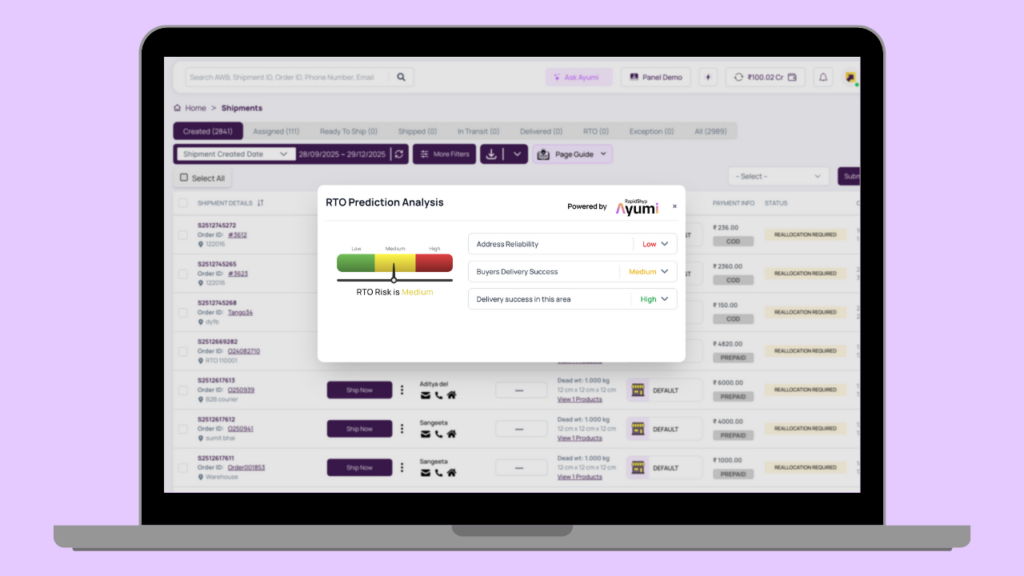
Ayumi Predict addresses this by evaluating each order before it is shipped. It analyses buyer history, past delivery outcomes, geographic reliability, and behavioural signals to assess the likelihood of an order being returned. Instead of flagging issues after a failed delivery attempt, it highlights risk at the source.
This early visibility allows sellers to take corrective action, such as verifying addresses, nudging buyers towards prepaid options, or holding back shipments that show a high probability of failure. Over time, this proactive approach leads to lower RTO rates, reduced shipping waste, and more predictable revenue.
Why Accurate Delivery Dates Matter More Than Speed
Fast delivery is valuable, but accurate delivery promises are far more critical to customer trust. Many sellers struggle with static ETAs that fail to account for real-world disruptions. When delivery dates slip, customer anxiety increases, support tickets pile up, and brand perception suffers.
Ayumi Promise focuses on improving delivery date accuracy by analysing historical lane performance, courier behaviour, and real-time network conditions. Instead of offering generic timelines, it predicts delivery dates based on how shipments actually move through specific routes and regions.
Because the system continuously learns, its predictions adapt during peak seasons, regional demand surges, or courier backlogs. For sellers, this translates into fewer missed promises, lower support volume, and stronger post-purchase confidence among buyers.
Rethinking Courier Selection with AI
Courier allocation is one of the most underestimated decisions in logistics. Many sellers rely on default settings or cost-based selection, unaware that courier performance can vary drastically by pin code, lane, and time period. A courier that performs well in metros may struggle in remote regions, while another may excel in specific zones.
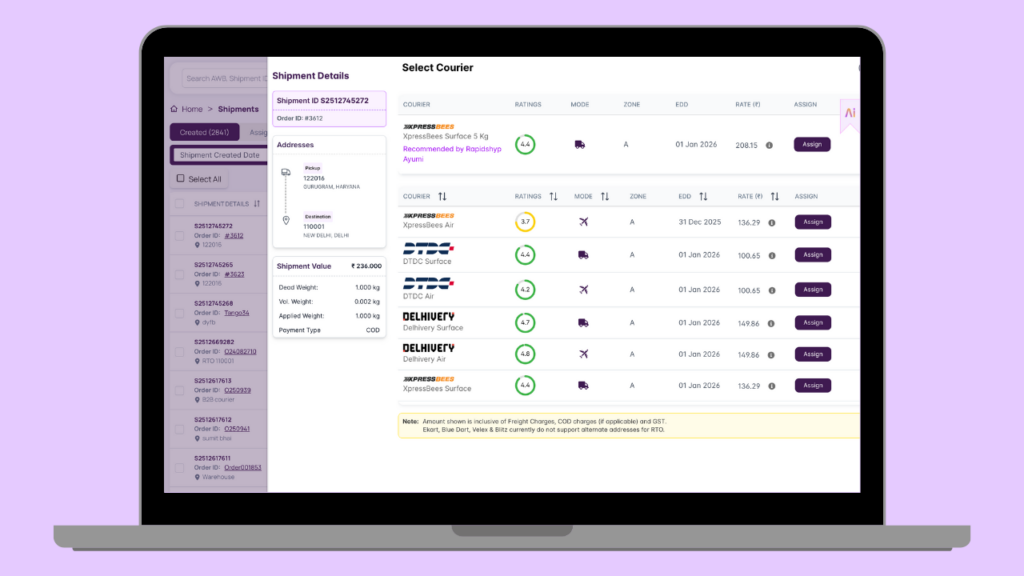
Ayumi Select removes this guesswork by evaluating couriers based on historical success rates, real-time operational load, and lane-specific performance. Each shipment is matched with the courier most likely to deliver successfully, not just the one that appears cheapest or fastest on paper.
This approach improves first-attempt delivery success, reduces reattempts, and minimises avoidable exceptions. Over time, sellers experience smoother operations and lower hidden costs associated with failed deliveries.
AI Assistance in Day-to-Day Logistics Operations
As businesses scale, logistics data becomes harder to interpret. Sellers often spend hours navigating dashboards, pulling reports, and responding to exceptions. This operational overhead can slow decision-making and distract from growth.
Ayumi Sense introduces AI-assisted interaction into logistics workflows. Through chat and voice, sellers can quickly understand performance trends, identify problem areas, and act on insights without manual analysis. This shifts logistics management from reactive troubleshooting to informed, real-time decision-making.
AI in logistics is often perceived as an enterprise-only capability, but its impact is equally significant for small and mid-sized sellers. In fact, businesses with tighter margins benefit the most from reduced RTOs, accurate delivery promises, and efficient courier allocation. Ayumi adapts to shipment volume and evolves with each seller’s data, making it relevant across different growth stages.

Trust, Data Security, and AI Adoption
For AI systems to be effective, trust is essential. Ayumi adheres to strict data security standards, ensuring seller information remains protected and anonymised during model training. This allows sellers to benefit from collective intelligence without compromising privacy.
The Shift from Shipping Tools to Intelligence Platforms
The future of logistics lies not in more dashboards, but in better decisions. AI-driven systems like Ayumi represent a shift from execution-focused shipping platforms to intelligence-led logistics ecosystems. By predicting outcomes, learning from data, and adapting to real-world conditions, AI enables sellers to operate with greater confidence and control.
AI is not changing logistics by making deliveries marginally faster. It is changing logistics by making it predictable, explainable, and resilient. For online sellers navigating complexity at scale, this shift can mean the difference between constant firefighting and sustainable growth.
RapidShyp Ayumi illustrates how AI can move logistics beyond automation and into intelligence, helping sellers anticipate challenges, optimise decisions, and build a more reliable delivery experience.


Calculate Your Shipping Rates

| Courier Partner | Mode | Chargeable Weight (KG) | Shipping Rates |
|---|


