


Table of Contents
Let’s face it- when you hear “B2B,” you don’t immediately think exciting. You think of long emails, endless procurement chains, and that classic PDF catalogue no one ever updated.
But here’s the thing- B2B eCommerce isn’t just undergoing a glow-up. It’s completely changing the way businesses buy, sell, and scale. What was once a rigid, offline process driven by cold calls and meetings is now being reimagined as a fast, dynamic, and tech-powered marketplace.
In this blog, we’re not just going to explain the B2B eCommerce model; we’ll explore the why behind its rise, the perks and pitfalls that come with it, and the real-world trends shaping its next chapter.
What is B2B eCommerce?
Think of it like this: instead of selling sneakers to shoppers, you’re selling 50,000 shoelaces to the sneaker brand itself. That’s B2B in action, business to business. And in the B2B eCommerce world, this all plays out online.
No phone tag. No faxes. Just streamlined transactions through digital portals and B2B online marketplaces. From manufacturers to wholesalers, distributors to retailers- everyone’s logging in instead of locking down meetings.
And unlike B2C, where emotions sometimes drive impulse buys, the B2B model is all strategy. Bulk orders, complex pricing, negotiated contracts, and long-term relationships define this game.
But while it’s more structured, it’s also far more scalable, if you play it right.
Why B2B eCommerce Works (When It Works)
Let’s not sugarcoat it. B2B used to be slow and clunky. But eCommerce has cracked it open with precision. When done right, the benefits aren’t just marginal, they’re massive.
First up: revenue. Bulk buying means bigger order values, which means predictable, recurring revenue. And since you’re dealing with fewer, but more valuable, customers, your acquisition costs shrink dramatically.
Then there’s automation. Orders, invoices, shipping, customer management—all digitised. No more back-and-forth. Just seamless flow.
And don’t forget reach. A physical sales team might tap into one region. A well-optimised B2B online marketplace? That’s global exposure, with zero extra boots on the ground.
But maybe the real win? Trust. Once you’re in with a business, they stick. Long-term contracts, repeat orders, referrals. It’s not transactional, it’s transformational!
Advantages of the B2B eCommerce Model
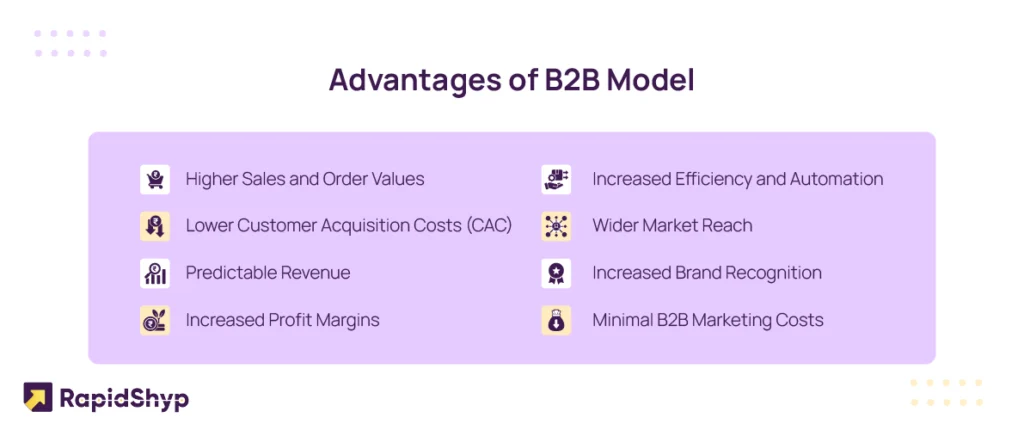
Let’s be honest- when businesses start selling to other businesses online, the dynamics shift. You’re no longer counting individual transactions- you’re building pipelines. Long-term deals, high-volume orders, and repeat business become the norm, not the exception.
And that shift comes with real advantages, ones that go far beyond just being “digital.”
Higher Sales and Order Values
B2B buyers don’t deal in single units; they buy in bulk. That means every transaction brings in significantly more value compared to B2C.
Lower Customer Acquisition Costs (CAC)
Once a business signs on, it tends to stay. Long-term contracts and repeat orders mean you’re not constantly spending to reacquire the same customer.
Predictable Revenue
With ongoing business relationships and recurring orders, forecasting becomes easier, and a steadier cash flow follows.
Increased Profit Margins
When orders are larger and operations are more streamlined, the cost per transaction drops and your margins go up.
Increased Efficiency and Automation
Manual order-taking is replaced with automation, from order processing to invoicing, freeing up time and reducing errors.
Wider Market Reach
A digital storefront isn’t bound by location. With a strong B2B eCommerce platform, you can tap into new cities, states, or even countries, without opening a single branch.
Increased Brand Recognition
A polished B2B online marketplace presence builds credibility. It shows you’re not just a supplier, you’re a serious, scalable business.
Minimal B2B Marketing Costs
Because you’re targeting fewer, high-value clients, your marketing can be laser-focused and far more cost-effective.
The B2B model isn’t just lucrative. When done right, it’s efficient, repeatable, and built to scale.
Challenges in the B2B eCommerce Model You Need to Know
Of course, even the best machines have friction points.
B2B eCommerce solutions come with their share of quirks. The first? Your market is smaller. Unlike B2C, where anyone with a card can buy, B2B has a narrower lane- specific industries, specific needs. That’s great for specialisation but risky for smaller businesses that can’t afford to miss.
Then there’s the decision-making maze. You’re not selling to a person. You’re selling to a team. Procurement managers, finance heads, legal departments, everyone wants a say. That means longer cycles, more negotiation, and delayed gratification.
And let’s be honest- your buyers? They call the shots. They want customisation. They want flexible payment terms. They want their terms, not yours. It flips the power structure, and you need to be ready for that.
Read More: B2B Logistics in 2026: Trends, Challenges & Proven Solutions
What’s Changing: Trends You Can’t Ignore
Despite the challenges, the B2B world is evolving fast, and the trends are telling a bigger story.
A New Kind of Buyer
Gone are the old-school procurement pros. Today’s B2B buyer is younger, sharper, and doesn’t want to talk to sales until they absolutely have to. They’re scrolling on their phones, expecting the same sleek experience they get on B2C sites. If your portal feels like it’s from 2008? They’ll bounce.
Mobile Isn’t Optional
80% of B2B buyers use mobile in the purchase journey. Price comparisons, product specs, reorders- if your platform isn’t mobile-optimised, you’re out of the running before you’re even in.
Personalisation Becomes the Price of Entry
Forget one-size-fits-all. AI-driven personalisation is the new normal. Dynamic pricing, custom catalogues, smart recommendations, and B2B eCommerce solutions are no longer about listing products. They’re about understanding behaviours and serving precision.
Is the B2B eCommerce Model Right for Your Business?
Here’s the truth: the B2B eCommerce model isn’t for everyone. It’s not plug-and-play. It demands strategy, tech investment, and a long view.
But for those who commit? The rewards are deep. Recurring revenue. Efficient operations. Global reach. Long-term client relationships.
Whether you’re selling raw materials, industrial machinery, or 10,000 units of biodegradable packaging, the potential is enormous.
Just make sure your logistics don’t let you down.
The Shipping Reality: Why B2B Logistics Is a Different Beast
If you’ve got your product, platform, and pricing strategy figured out, great. But here’s the catch: B2B eCommerce success often hinges on one silent make-or-break factor- shipping.
Unlike B2C, B2B shipping isn’t about delivering a single parcel to a doorstep. It’s about moving bulk shipments, often across multiple locations, within fixed time windows, and sometimes to destinations that don’t even have a formal address—like a warehouse gate, a vendor’s stall at an expo, or a third-party distribution hub.
Miss a delivery slot, and you’re not just dealing with a delay. You’re risking penalties, strained business relationships, or losing the next big order.
Here’s why B2B shipping demands a different playbook:
Higher Stakes, Bigger Loads: You’re often shipping pallets or truckloads, not small packages.
Appointment-Based Deliveries: Many clients require pre-scheduled deliveries to docks or storage units- no margin for late arrivals.
Multiple Routing Needs: One order might split across 3 cities, 6 stores, and 12 franchisees.
Custom Handling & Coordination: From fragile inventory to temperature-sensitive goods, the need for tailored logistics is real.
This is where tech-backed, B2B-ready logistics solutions like RapidShyp come in. You need more than tracking- you need complete visibility, control, and reliability.
Because in B2B, your shipping partner isn’t just delivering your product. They’re delivering your reputation.
How RapidShyp Powers Scalable B2B eCommerce Solutions
Here’s where things get real. Because even the best eCommerce strategy falls flat without smooth shipping. And B2B logistics isn’t like B2C, you’re not delivering a parcel to someone’s apartment. You’re managing cargo that needs coordination, scale, and muscle.
RapidShyp understands the B2B rhythm. You need truckloads, sometimes full, sometimes partial, moved on tight timelines. You need air cargo shipped across metros, routed to multiple warehouses or franchise locations. Sometimes, you’re delivering not to addresses but to destinations- canteens, malls, retail kiosks.
There are days when everything depends on hitting that appointment-based delivery window. And others when your client needs it dropped door-to-door, no questions asked.
B2B shipping is not just about logistics- it’s about orchestration. And that’s what we do best.
We don’t just ship. We move your business forward.


Calculate Your Shipping Rates

| Courier Partner | Mode | Chargeable Weight (KG) | Shipping Rates |
|---|


