


Table of Contents
Shipment tracking in B2B logistics has long been a passive observer rather than an active problem-solver. Traditional B2B shipment tracking tells you where a shipment is, but not what its delay will cost you. A tracking number is provided, along with a few scan updates along the way; stakeholders are expected to wait until the following status update. But as supply chains grow more complex and delivery expectations tighten, this passive approach to tracking is no longer enough. Today’s B2B logistics environment demands something far more dynamic- real-time visibility that actively drives decisions, not just updates dashboards.
This shift from “knowing where a shipment was” to “understanding what’s happening right now” is quietly redefining shipping efficiency across industries.
How Traditional Shipment Tracking Falls Short
Traditional tracking systems are built around milestone scans- picked up, in transit, out for delivery, delivered. While this model may work in simpler logistics environments, it breaks down quickly in B2B shipping, where shipments are larger, routes are longer, dependencies are tighter, and delays have cascading effects.
The core problem is latency. By the time a scan update reflects a delay, the damage is often already done. Warehouses remain idle, dock appointments are missed, downstream production schedules are disrupted, and customer communication becomes reactive rather than proactive. Traditional tracking tells you that something went wrong, but rarely tells you why, how serious it is, or what to do next.
In a B2B context, where one delayed shipment can stall an entire operation, this lack of actionable insight becomes a critical inefficiency.
The Growing Complexity in B2B Logistics
B2B shipping today operates in an environment of increasing complexity. Businesses are managing multi-leg transportation, cross-border compliance, appointment-based deliveries, diverse carrier networks, and tighter SLAs all simultaneously. Add fluctuating fuel costs, traffic congestion, labour shortages, and geopolitical disruptions, and the margin for error becomes razor-thin.
What makes this complexity harder to manage is fragmentation. Data is scattered across carriers, systems, and stakeholders. Logistics teams are forced to manually chase updates, reconcile conflicting information, and make decisions with incomplete visibility. In such an environment, speed alone doesn’t drive efficiency- clarity does.
This is precisely where real-time visibility begins to matter.
Real-Time Visibility as the Shift
Real-time visibility represents a fundamental shift in how B2B shipping is managed. Instead of waiting for periodic updates, logistics teams gain real-time visibility into shipment movements, delays, route deviations, and potential risks.
This shift transforms logistics from a reactive to a predictive function. Problems are identified earlier, decisions are made faster, and outcomes become more controllable. Real-time tracking doesn’t just inform- it empowers.
What is Real-Time Visibility?
At its core, real-time visibility refers to the continuous flow of live shipment data throughout the transportation lifecycle. This data is typically powered by GPS, telematics, carrier integrations, and intelligent analytics that interpret movement patterns in real time.
Unlike traditional tracking, which relies on discrete events, real-time visibility provides context. It accounts for traffic conditions, driver behaviour, route changes, weather disruptions, dwell times, and more- offering a living, breathing picture of shipment progress.
What is Real-Time Visibility in B2B Shipping?
In B2B shipping, real-time visibility goes beyond location tracking. It connects shipments to business outcomes. A delayed truck is not just a logistics issue- it’s a missed dock appointment, a production slowdown, or a dissatisfied enterprise customer.
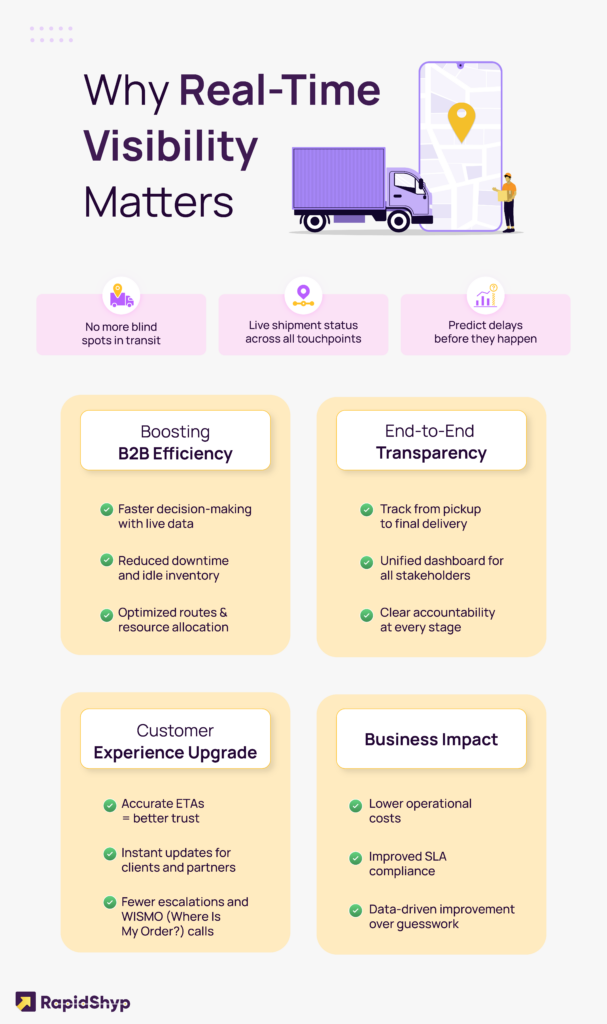
Real-time visibility in B2B shipping allows stakeholders to anticipate these impacts early. Delivery managers can adjust ETAs dynamically, warehouses can reschedule labour, procurement teams can plan inventory buffers, and customers can be informed proactively with accurate timelines.
The result is not just better tracking- but better orchestration across the entire supply chain.
Why is Real-Time Better?
The traditional “scan-and-see-you-later” model assumes that visibility equals information. In reality, visibility equals actionability. Scan-based tracking leaves long gaps of uncertainty between updates, forcing teams to operate on assumptions.
Real-time tracking fills those gaps. It enables logistics managers to make precise, data-driven decisions using real-time information on shipment locations, traffic congestion, route deviations, and driver availability. This precision minimises errors, reduces delivery time, and prevents costly last-minute firefighting.
In an environment where timing is everything, delayed information is almost as bad as no information at all.
Key Challenges Caused by the Lack of Real-Time Transportation Visibility in B2B Shipping
When real-time visibility is absent, inefficiencies multiply quietly. Manual intervention becomes the norm, with teams constantly calling carriers and drivers for updates. Detention and demurrage costs rise because delays in loading and unloading go unnoticed until penalties are incurred.
Operational risks also increase. Without early warning signals, disruptions escalate into full-blown failures. Shipment security suffers, compliance becomes more complicated to manage, and customer trust erodes due to inconsistent or inaccurate communication.
Over time, these challenges compound, turning logistics into a cost centre rather than a strategic advantage.
How Real-Time Visibility Is Transforming B2B Shipping
Real-time visibility fundamentally changes how B2B shipping decisions are made. With up-to-the-minute data, businesses can optimise routes dynamically, club pickups and deliveries more efficiently, and reduce empty miles. Inventory planning becomes more accurate because inbound and outbound movements are no longer guesswork.
Automation also plays a key role. Real-time transportation visibility minimises manual coordination, freeing teams from repetitive, low-value tasks and allowing them to focus on strategic initiatives. Communication across drivers, warehouses, logistics teams, and customers becomes seamless and synchronised.
Most importantly, disruptions are managed proactively. Instead of reacting to delays, businesses can anticipate them, reroute shipments, adjust schedules, and maintain service continuity- even in unpredictable conditions.
Business Impact: What Companies Actually Gain
The business impact of real-time tracking in B2B shipping is tangible. Operational efficiency improves as decisions become faster and more accurate. Cost savings follow naturally from reduced waste, lower detention charges, and more intelligent resource allocation.
Real-time visibility also unlocks data-driven insights. Every shipment becomes a source of intelligence, helping businesses identify patterns, uncover inefficiencies, and plan future logistics strategies with confidence. Over time, this data becomes a competitive asset rather than just an operational record.
Perhaps most importantly, it fuels innovation. Real-time data lays the groundwork for advanced capabilities such as AI-powered automation, logistics digital twins, and intelligent contract execution- shaping the future of B2B supply chains.
Real-Time Visibility as a Foundation for the Future
As B2B shipping continues to evolve, real-time visibility will no longer be optional. It will serve as the foundation for resilient, adaptive, and intelligent supply chains.
Businesses that invest in real-time tracking today are not just solving current inefficiencies- they are future-proofing their operations. They are building systems that can learn, adapt, and scale alongside market demands.
Key KPIs Enabled by Real-Time Visibility in B2B Shipping
Real-time visibility enables continuous monitoring of critical KPIs, including on-time delivery performance, transit time variability, causes of delay, route deviations, detention time, and asset utilisation. Unlike static reports, these KPIs are tracked in real time, enabling immediate corrective action rather than post-mortem analysis.
This shift from retrospective reporting to real-time performance management fundamentally changes how logistics success is measured and achieved.
Achieve a Real-Time and Unified View of All Shipments with RapidShyp Cargo+
In a fragmented logistics ecosystem, achieving accurate real-time visibility requires more than just carrier integrations- it requires intelligence. RapidShyp Cargo+ brings this intelligence to B2B shipping by offering a unified, real-time view of all shipments across carriers, routes, and regions through a branded tracking page.
By consolidating live shipment data into a single platform, RapidShyp enables businesses to make faster, smarter decisions throughout the shipping lifecycle. From accurate ETAs and proactive disruption management to data-driven planning and operational optimisation, RapidShyp Cargo+ transforms real-time tracking into a strategic advantage.
Because in modern B2B shipping, visibility isn’t about knowing where a shipment is- it’s about knowing what to do next.


Calculate Your Shipping Rates

| Courier Partner | Mode | Chargeable Weight (KG) | Shipping Rates |
|---|


