

Table of Contents
Every online business remembers its first shipped order. The product, website, payment modes, etc might have been perfect. But what actually carried that order from your warehouse to your customer’s hands wasn’t your brand story or your marketing copy. It was a courier bag- quiet, uncelebrated, and often chosen at the last minute.
Most sellers don’t think about courier bags until something goes wrong. A torn parcel. A soaked box during the monsoon. A customer shares an unboxing reel where the packaging looks cheap, crumpled, or mismatched to the product inside. Suddenly, that “just a bag” becomes a brand liability.
Courier bags aren’t just packaging. They are storage, protection, cost control, brand exposure, and operational efficiency rolled into one thin layer of material when it comes to online stores. Choosing the right one can save you money, reduce returns, speed up fulfilment, and quietly elevate how customers perceive your brand.
Let’s unpack courier bags the way a seller should: not as SKUs, but as business tools.
Why Courier Bags Matter for Online Storage and Shipping
In the early days of online selling, cardboard boxes were mostly used. They felt sturdy, professional, and familiar. But as order volumes grew and margins tightened, sellers began noticing the hidden costs, storage space, higher shipping weight, slower packing times, and rising courier charges.
Courier bags quietly solved many of these problems. They take up significantly less space in your warehouse, allowing you to store thousands of units where boxes would occupy racks. They’re lighter, which directly reduces volumetric and dead weight charges. They’re faster to pack, cutting seconds off every order, a small gain that compounds massively at scale.
Most importantly, courier bags are designed for transit, not shelving. They’re made to survive conveyor belts, sorting hubs, rain-soaked delivery vans, and rushed last-mile handling. For products like apparel, accessories, documents, soft goods, and even well-packed electronics, courier bags offer protection without unnecessary bulk.
Over time, they didn’t just become an alternative. They became the standard.
Courier Bags as the First Physical Touchpoint of Your Brand
For D2C brands especially, courier bags play a role that’s easy to underestimate. In an online-first business, this is often the first physical interaction a customer has with your brand. Before they touch the product, they touch the bag.
A flimsy, noisy, low-quality bag subconsciously signals cost-cutting. A clean, sturdy, well-sealed bag signals professionalism and reliability, even before the product is revealed. This is why large marketplaces like Amazon and Flipkart obsess over courier bag quality. Not because customers consciously notice them, but because they feel the difference.
For independent sellers, this moment matters even more. You may not control the delivery executive or the last-mile experience, but you do control what the customer receives in their hands. The courier bag is your silent representative.
Understanding Courier Bag Materials
Not all courier bags are created equal, even when they look similar. The material determines durability, cost, weather resistance, and sustainability, which are four factors every seller eventually has to balance.
Most standard courier bags are made from polyethene-based plastics, but the thickness, layering, and treatment make a significant difference. Low-density polyethene (LDPE) and high-density polyethene (HDPE) are commonly used, with LDPE offering more flexibility and tear resistance, while HDPE feels stiffer and crisper.
For sellers shipping apparel or soft goods, flexible LDPE-based bags tend to perform better because they absorb pressure rather than tearing under stress. For documents or flatter items, slightly stiffer materials help maintain shape and presentation.
Increasingly, suppliers are also offering co-extruded layers, i.e. multiple thin layers fused together to improve strength without significantly increasing weight. This allows bags to be lightweight yet resistant to punctures and rough handling.
Then there’s water resistance. Most courier bags are water-resistant by default, but not all are waterproof. During heavy rains or prolonged exposure, low-quality bags can allow moisture seepage through seams or closures. Sellers operating in regions with monsoon seasons or high humidity should pay special attention to sealing quality and layered construction.
Plain Courier Bags
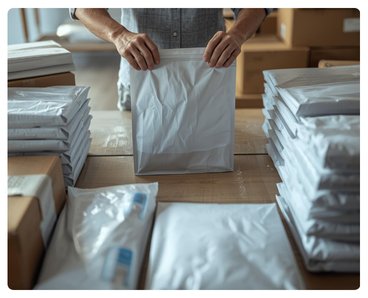
Plain courier bags don’t look exciting, but they run the backbone of online retail. These are the bags you’ll find moving millions of orders every day, from T-shirts, kurtas, kidswear, books, to cosmetics and soft home goods. Their simplicity is their strength. No unnecessary compartments, no added bulk, just a strong outer layer with an adhesive seal.
What makes a good plain courier bag isn’t how it looks, but how it performs after leaving your warehouse. A high-quality plain bag resists tearing even when overstuffed slightly, holds its seal through multiple touchpoints, and doesn’t thin out at stress points like corners and folds.
For sellers managing large volumes, plain courier bags offer predictability. They’re easier to stack, quicker to pack, and cheaper to source in bulk. When margins are tight, this predictability matters more than novelty. Many sellers choose subtle branding, internal colour contrasts, or printed instructions inside the bag to enhance the customer experience without dramatically increasing costs.
POD Courier Bags
Some businesses can’t afford ambiguity in delivery. B2B sellers, invoice-driven operations, legal document couriers, and high-value shipments often require proof not just of delivery, but of documentation integrity.
This is where POD courier bags come into play.
These bags typically include integrated document pouches, usually transparent, that securely hold invoices, delivery challans, or manifests. The key advantage is separation without detachment. Documents remain visible and accessible without opening the main compartment, reducing the risk of loss or damage.
For businesses handling returns, COD orders, or regulated shipments, POD bags add a layer of operational discipline. They make audits easier, disputes faster to resolve, and delivery confirmations more reliable.
While they cost more than plain courier bags, POD bags often save money indirectly by preventing documentation errors, reducing customer disputes, and improving internal tracking.
Courier Bags as Storage Tools, Not Just Shipping Supplies
One overlooked aspect of courier bags is their role before shipping even begins.
In warehouses, courier bags often double as temporary storage. Picked orders are placed inside bags and queued for quality checks, labelling, or batching. In this context, the bag must hold its shape, remain identifiable, and protect the product even before dispatch.
Low-quality bags can tear or deform while sitting in storage cages, leading to re-packing and wasted time. High-quality bags maintain integrity even when stacked, shifted, or held for hours before pickup.
For D2C brands running flash sales or peak campaigns, this becomes critical. The right courier bag doesn’t just survive delivery; it supports your entire fulfilment workflow.
How Courier Bag Costs Actually Work (And Why Cheaper Isn’t Always Better)
Courier bag pricing can feel deceptively simple at first glance. But the real cost isn’t the per-unit rate, it’s the total impact on your operations.
Material quality is the biggest driver of price. Thicker, layered, or reinforced bags cost more upfront but reduce damage, returns, and repacking. For sellers shipping high volumes, even a small reduction in return rates can justify a higher bag cost.
Bag size also matters more than most sellers realise. Oversized bags increase volumetric weight, which directly increases shipping costs. Undersized bags risk tearing or poor sealing. Choosing the right size for your product mix is one of the easiest ways to control logistics expenses.
Customisation adds another layer. Printed logos, brand colours, or custom messaging increase costs, but they also replace other branding expenses. Many D2C brands treat courier bags as moving billboards, especially when customers reuse them.
Order quantity significantly impacts pricing. Bulk orders reduce per-unit costs, but only if you have predictable demand and adequate storage. Over-ordering to chase discounts can backfire if designs change or materials degrade over time.
Finally, supplier reliability affects cost in less obvious ways. Late deliveries, inconsistent quality, or poor after-sales support can disrupt fulfilment far more than a slightly higher per-unit price from a dependable supplier.
Read More: The Real Cost of Packaging and How to Optimise It for Profitability
What to Look for in a Courier Bag Supplier (Beyond Price)
A good supplier doesn’t just sell bags. They understand shipping realities. Consistency in material quality, accurate sizing, reliable lead times, and responsive support matter more than flashy catalogues. Reviews help, but long-term sellers often judge suppliers by how they handle problems, not how they perform when everything goes right.
The best suppliers also adapt. They offer evolving materials, improved sealing technology, and customisation options as your business grows. In eCommerce, where volumes and brand needs change quickly, flexibility is as valuable as cost.
The Quiet Competitive Advantage of Choosing the Right Courier Bag
Courier bags will never be the hero of your marketing campaign. Customers won’t buy from you because of them. But they will remember how receiving your order felt.
In a space where products are easy to copy and ads are easy to skip, operational excellence becomes a differentiator. And courier bags, simple as they seem, are a part of that excellence.
When chosen thoughtfully, they protect your products, support your workflows, control your costs, and reinforce your brand without saying a word. For eCommerce and D2C sellers, that’s not just packaging. That’s leverage.


Calculate Your Shipping Rates

| Courier Partner | Mode | Chargeable Weight (KG) | Shipping Rates |
|---|

