


Table of Contents
A customer clicks “Place Order.” That moment feels like the end of a journey – but for brands, it’s just the beginning.
Between checkout and doorstep lies the most emotionally charged phase of the customer experience: delivery. It’s where excitement builds, trust is tested, and loyalty is either strengthened or silently lost.
In a market overflowing with choices, customers don’t stay loyal to the loudest brand – they stay loyal to the one that shows up on time. Faster delivery has quietly moved from being a competitive edge to becoming the emotional glue that holds customer trust together. For brands that get it, delivery isn’t backend logistics; it’s the experience customers remember.
This blog explores why quick delivery works, the psychology behind it, the real ROI of same-day and next-day shipping, and how AI-driven shipping aggregators like RapidShyp are helping brands deliver faster, smarter, and more reliably.
Why Does Delivery Time Feel Longer Than It Is?
Time behaves differently after checkout.
A two-day delay in everyday life feels normal. A two-day delay after placing an order feels unbearable. This isn’t impatience, it’s psychology. Once a customer pays, the brain switches from anticipation to ownership. The product already feels like it belongs to them. Any delay feels like something is being withheld.
This is why quick delivery doesn’t just satisfy customers, it calms them.
Every additional day in transit increases uncertainty. Customers begin checking tracking links more often. They compare ETAs with competitors. They wonder if they made the right choice. None of this is conscious, but all of it affects how they remember your brand.
Faster delivery shortens this emotional gap. It compresses uncertainty. It replaces anxiety with relief.
Why Fast Shipping Builds Long-Term Customer Loyalty
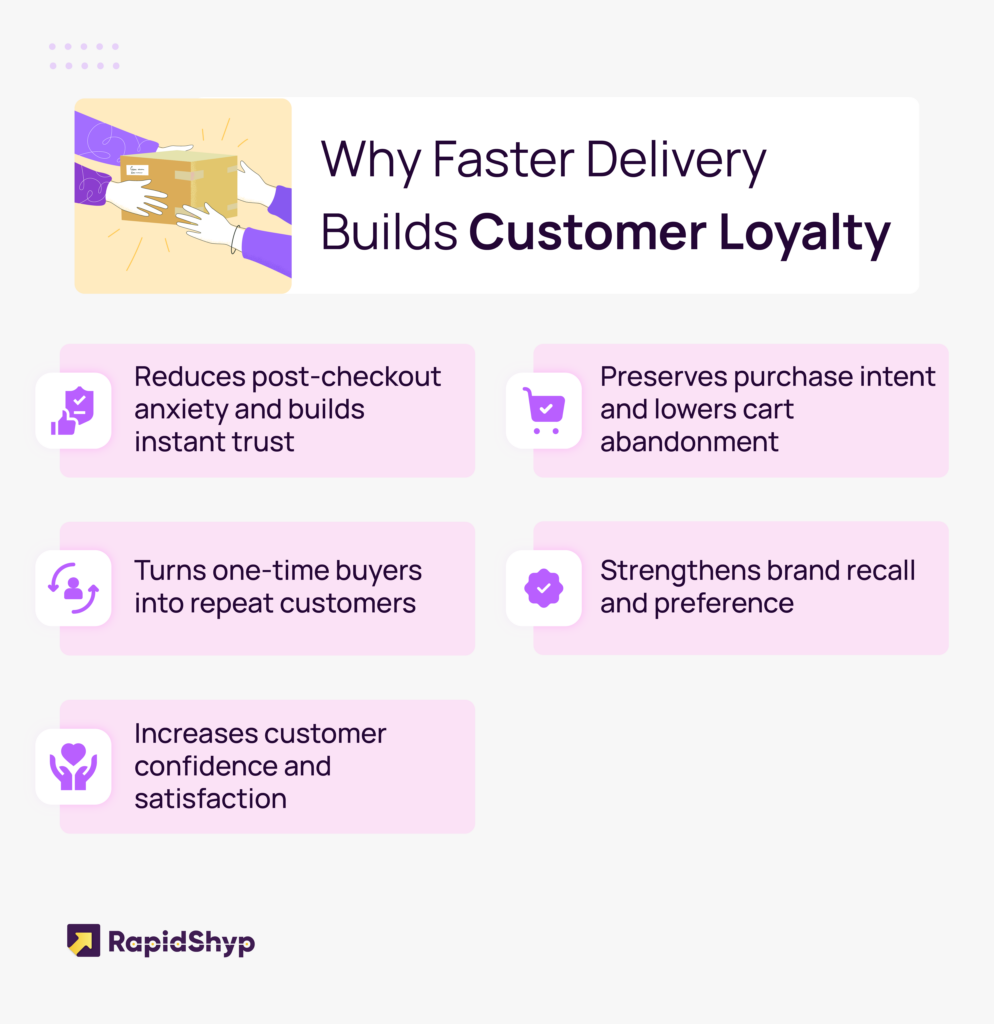
Customer loyalty isn’t built through persuasion. It’s built through repetition.
When customers consistently receive their orders quickly, a subtle shift happens. They stop actively choosing your brand, and start defaulting to it. The next time they need the same product, they don’t search again. They return.
This is the hidden power of faster delivery. It turns a brand into a habit.
A brand that delivers quickly once creates delight. A brand that delivers quickly every time builds trust. And trust, when repeated, becomes loyalty.
How Faster Delivery Reduces Cart Abandonment
Cart abandonment is often blamed on indecision. In reality, it’s usually caused by delay.
Customers reach checkout with full intent to purchase. But long shipping timelines or high delivery costs drain momentum from the experience. What felt exciting seconds ago suddenly feels inconvenient.
Next day delivery counters this drop-off sharply. When customers see fast and reliable shipping options, the checkout journey feels complete instead of conditional. There’s no waiting, no uncertainty, no reason to “come back later.”
Speed preserves intent, and intent converts.
Faster Shipping as a Competitive Advantage in eCommerce
Most online stores sell similar products. Many compete on price. Few compete on experience.
Faster delivery is one of the most effective ways to stand out because it’s immediately felt. Customers may forget discounts or ad creatives, but they remember how long they waited for their order.
Over time, this memory becomes preference. When faced with multiple options, customers lean toward the brand that delivered faster the last time. That preference compounds into repeat purchases, positive reviews, and organic word-of-mouth. Speed becomes differentiation without noise.
How Fast Delivery Increases Customer Trust in Online Shopping
Trust is fragile in eCommerce. Customers have unlimited choice and limited patience.
Offering faster shipping sends a strong signal of operational confidence. It suggests that your systems are prepared, your processes are reliable, and your brand knows how to execute. Even before the parcel arrives, trust is already forming.
This trust influences behaviour. Customers are more comfortable with prepaid orders. They’re more likely to leave positive reviews. They’re also more forgiving of minor hiccups because the core promise, delivery, was fulfilled. Fast delivery becomes a credibility shortcut.
The Operational Challenges of Instant and Quick Delivery
Delivering fast is easy to promise. Delivering fast consistently is difficult.
Instant and quick delivery models introduce operational complexities that many brands underestimate. Poor order forecasting leads to inventory shortages and workforce misalignment, especially in categories involving perishables or high-demand SKUs.
Lack of real-time visibility compounds the problem. Without live tracking, delivery managers lose control over order movement. Delays go unnoticed. Communication breaks down. Customer confidence erodes.
Speed without visibility creates risk.
Why Most Brands Struggle to Deliver Fast at Scale
As order volumes increase during peak hours, sales events, or festive seasons, small inefficiencies become large failures.
Manual courier assignment, static routing, and habit-based decisions don’t scale. What worked last month silently fails this month. Missed deliveries increase. Costs rise. Reviews suffer.
In the rush to deliver faster, many brands also lose focus on sustainability. Routes become inefficient, vehicles run empty miles, and fuel costs spike. Speed without planning becomes expensive.
How Intelligent Planning Makes Faster Delivery Sustainable
True delivery efficiency doesn’t come from pushing drivers harder or onboarding more vehicles. It comes from intelligence.
Routes must be dynamically optimised. Inventory updates must be real-time. Assets must be utilised optimally. Without proper streamlining, businesses face higher fuel consumption, urgent hiring costs, and underused fleets.
Speed driven by systems, not urgency, is the only speed that scales profitably.
Why Faster Delivery Is a Growth Strategy, Not Just Logistics
At its core, faster delivery is not an operational upgrade. It’s a strategic choice.
When executed intelligently, it improves conversion rates, builds trust, increases visibility, and strengthens customer loyalty. When executed blindly, it inflates costs and damages brand reputation.
The brands that win aren’t the ones delivering fastest at any cost. They’re the ones delivering predictably, intelligently, and consistently.
How RapidShyp Helps Brands Deliver Faster, Without the Chaos
Faster delivery doesn’t fail because brands lack intent. It fails because speed, at scale, is impossible without intelligence.
This is where Ayumi, RapidShyp’s AI-powered intelligence engine, comes in. Ayumi is not just another shipping tool layered onto existing workflows. It is an AI-enabled courier recommendation and allocation engine designed to think through every delivery decision the way an experienced operations team would, only faster, continuously, and without bias.
At the core of Ayumi is the ability to identify the fastest courier for each individual shipment, not based on assumptions or static rules, but on live intelligence. It evaluates lane-wise courier performance, pin-code–level delivery success rates, historical delay patterns, and real-time courier signals to recommend the courier most likely to deliver on time, every time.
This means next-day delivery stops being a promise based on hope. It becomes a prediction backed by data.
Ayumi also brings clarity to one of the most fragile parts of the customer experience: delivery timelines. Instead of generic ETAs, it helps brands assess accurate delivery dates, grounded in real performance data. Customers are told what will actually happen, not what looks good on a product page. And accuracy, more than optimism, is what builds trust.
Beyond speed, Ayumi is designed to think defensively. It predicts risky shipments before they fail. By analysing millions of shipment data points, buyer behaviour patterns, and historical RTO indicators, Ayumi flags orders that are likely to face delivery issues, whether due to location, courier behaviour, or past buyer interactions. This allows brands to take corrective action early, instead of reacting after damage is done.
What truly differentiates Ayumi is that it learns continuously. Every successful delivery sharpens its understanding. Every failed attempt improves future decisions.
Ayumi learns from millions of shipments flowing through the RapidShyp ecosystem, constantly refining its courier recommendations, route intelligence, and cost-performance trade-offs. Over time, delivery times shorten, RTOs decline, and operational inefficiencies quietly disappear.
Ayumi isn’t built just for optimisation, it’s built for control and clarity. By bringing together predictive intelligence, machine learning, automation, and real-time operational insights, Ayumi gives brands a single, unified decision layer. Teams no longer need to juggle dashboards, spreadsheets, and gut instinct. Decisions that once took hours are made automatically, in seconds, with confidence.
This is why Ayumi exists. Because fast-growing eCommerce brands don’t need another shipping panel, they need a system that thinks, learns, and acts alongside them. Every shipment becomes smarter. Every decision becomes faster. And, every delivery moves the business forward, predictably, profitably, and without chaos.


Calculate Your Shipping Rates

| Courier Partner | Mode | Chargeable Weight (KG) | Shipping Rates |
|---|


