


Table of Contents
Running an eCommerce brand often feels like a never-ending tug of war. On one end, there are customer promises- faster deliveries, lower shipping costs, accurate tracking, and flawless experiences. On the other end, there are logistics realities- carrier delays, rising surcharges, serviceability gaps, RTOs, and unpredictable seasonal disruptions. Every day, founders and operations teams are pulled between these two forces, trying to maintain a balance without letting either side win completely.
This struggle becomes far more intense when a business relies on a single courier partner. One courier means a fixed set of rates, one delivery network, limited capacity, and multiple failure points. A strike, a policy change, or a sudden surge in demand can instantly derail delivery timelines and damage customers’ trust. What looks like simplicity on paper often turns into fragility in practice.
This is where multi-carrier shipping enters, not as a buzzword, but as a strategic shift. Instead of depending on one road to reach every destination, brands build an entire highway system for their orders. Multiple routes, multiple speeds, and multiple fallback options ensure that shipments keep moving, even when one path breaks down. With the help of shipping aggregators and shipping aggregation technology such as RapidShyp, businesses no longer have to choose between speed, cost, and reliability. They can optimise for all three, shipment by shipment.
In this guide, we explore what multi-carrier shipping truly means, why it has become essential for modern eCommerce shipping, how businesses can select and benchmark couriers intelligently, and how to switch carriers without disrupting operations- all through a storytelling lens rooted in real-world logistics challenges.
What Is Multi-Carrier Shipping and Why Does It Matter So Much in India
At its simplest, multi-carrier shipping refers to the practice of using multiple courier partners instead of relying on a single logistics provider. These carriers are managed through a unified system, often a shipping aggregator like RapidShyp, that allows brands to compare rates, allocate shipments, and track deliveries from one place.
But in practice, multi-carrier shipping is far more powerful than a technical setup. It’s the difference between reacting to logistics problems and proactively designing around them. It allows brands to dynamically balance cost, speed, and reliability based on each shipment’s unique needs rather than forcing all orders through the same courier logic.
In India, this approach is not optional; it’s essential. India doesn’t have one eCommerce shipping market; it has hundreds, stitched together by geography, infrastructure, and customer expectations. Customers in metro cities expect same-day or next-day delivery, while customers in tier-2, tier-3 cities and remote regions often depend on specialised regional carriers for reliable service. Add to this the massive order spikes during events like Diwali, Big Billion Days, and year-end sales, and it becomes clear that no single courier can perform optimally across all scenarios.
Shipping costs in India also fluctuate sharply based on zone, weight, and delivery type. Without shipping aggregation, businesses often overpay simply because they lack visibility and alternatives. Multi-carrier shipping solves this by routing every order through the courier best suited to that shipment. The result is faster deliveries, lower costs, wider coverage, and the flexibility to switch instantly when performance dips.
The Rise of Multi-Carrier Shipping in Modern eCommerce
There was a time when single-carrier setups felt safe. Brands selected a single national courier, negotiated rates, and built their operations around that partnership. It was predictable, easy to manage, and worked well when customer expectations were lower and competition was limited.
That world no longer exists.
Today’s customers are impatient and unforgiving. A large majority expect delivery within two days, and younger shoppers increasingly expect same-day fulfilment. At the same time, tolerance for delays has collapsed. Slow shipping is now one of the biggest reasons for cart abandonment, and unexpected shipping costs drive customers away before checkout is even complete.
On the other side, carriers are under pressure. Capacity constraints during peak seasons, rising fuel costs, labour shortages, and frequent policy changes have made delivery networks less predictable. For brands, this creates a dangerous imbalance. When everything depends on one courier, any disruption, no matter how small, ripples across the entire customer experience.
Multi-carrier shipping changes this equation. By diversifying their courier mix, brands reduce dependency, regain negotiating power, and create redundancy in their logistics network. Shipping aggregators make this possible at scale by consolidating multiple carriers into one platform, allowing businesses to compare rates, track performance, and make data-driven decisions in real time.
What was once a strategy reserved for large enterprises has now become the standard for ambitious eCommerce brands.
Why Single-Carrier Strategies No Longer Work
The biggest flaw in single-carrier strategies is the illusion of stability. Loyalty to one courier may feel reassuring, but it often hides inefficiencies and risks that only surface when it’s too late.
Shipping rates, for example, rarely remain stable. Carriers frequently adjust fuel surcharges, dimensional weight calculations, oversized handling fees, and delivery area surcharges. A parcel that qualified as standard yesterday can suddenly become expensive overnight. Without alternative couriers, brands have no way to escape these cost increases.
Capacity is another major issue. During festive sales and promotional events, national carriers routinely cap volumes or prioritise larger clients. Smaller brands find themselves facing delayed pickups, slower deliveries, or sudden rate hikes- without warning.
New regional and hyperlocal players are outperforming legacy carriers in specific zones. Marketplace-backed logistics arms and gig-based delivery networks are reshaping last-mile delivery economics. Brands that stick to old loyalty models miss out on these improvements simply because they are not equipped to switch.
In a volatile small-parcel market, diversification is no longer a luxury. It is risk management.
Why Loyalty to a Single Carrier Can Quietly Kill Your Margins
Shipping costs rarely spike dramatically overnight. Instead, they creep up silently. Fuel surcharges increase by a few percentage points. Measurement tables change. New fees appear in invoices without clear explanations. Over time, these incremental increases can push shipping costs up by 30-35%, even when base rates appear unchanged.
This is where shipping aggregation becomes a financial lever. By comparing true landed costs across carriers, not just advertised rates, brands gain visibility into where money is being lost. Multi-carrier setups also create competitive pressure. When carriers know they are being benchmarked against others, pricing becomes more transparent and negotiable.
Loyalty without leverage benefits carriers far more than shippers.
Choosing the Right Multi-Carrier Shipping Solution
Not all shipping aggregators are built the same. Some merely offer access to multiple carriers, while others act as intelligent decision engines that actively optimise eCommerce shipping performance.
The right solution should feel invisible in daily operations while quietly making smarter decisions in the background. It should scale seamlessly during peak sales, integrate smoothly with order management systems, suggest the performance metrics of different carriers, zone-wise, provide accurate EDD and a link for tracking, billing, and analytics. Most importantly, it should turn logistics data into insights that help businesses grow rather than react.
When chosen well, a multi-carrier shipping platform becomes an extension of the brand’s promise to its customers.
Building a Winning Multi-Carrier Shipping Strategy
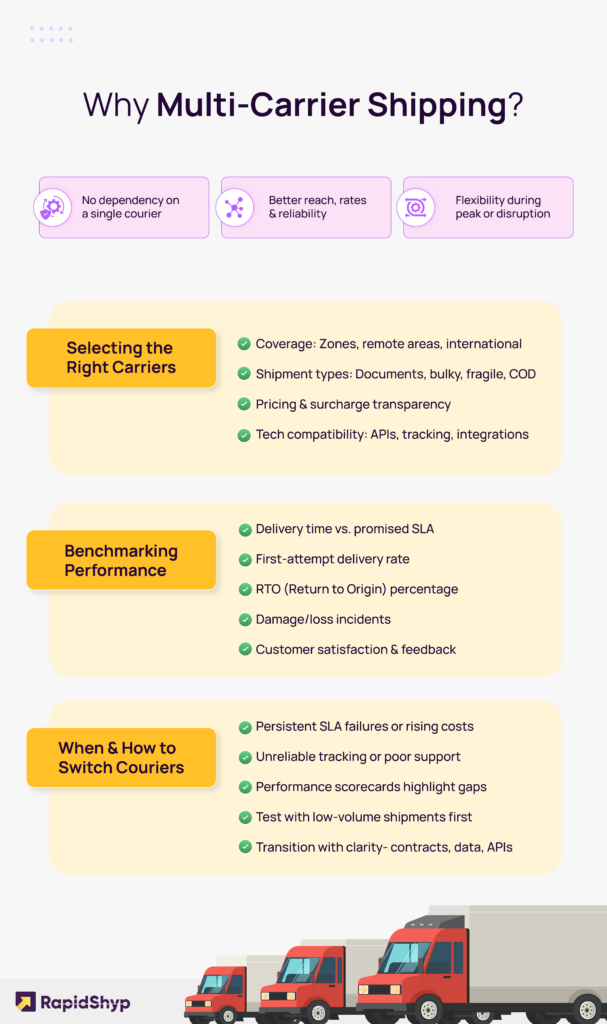
A successful multi-carrier strategy starts with understanding your own shipments. Brands must first analyse what they ship, where they ship, and how fast customers expect delivery. This clarity allows businesses to align specific parcel profiles with the carriers best suited to handle them.
Carrier relationships should then shift from transactional to collaborative. Instead of handing over all volumes to one partner, brands should distribute shipments strategically based on network strengths. This approach not only improves performance but also strengthens negotiation positions.
Benchmarking is critical. Rates, delivery performance, and exception rates should be reviewed regularly rather than assumed to be competitive. Shipping aggregators simplify this by offering real-time comparisons and historical performance data across carriers.
Technology plays a central role in making all of this scalable. Automated rate shopping, rule-based carrier allocation, and unified tracking ensure that every shipment is optimised without manual intervention. Over time, data-driven refinements further improve outcomes.
Common Pitfalls in Multi-Carrier Shipping (and How to Avoid Them)
Many brands undermine their multi-carrier efforts by moving too fast. Onboarding too many carriers at once can overwhelm teams and systems, leading to operational errors. A gradual, data-backed rollout is far more effective.
Another common mistake is neglecting contract reviews. Carrier agreements evolve, and failing to re-benchmark annually often results in hidden cost leakages. Similarly, revealing full shipment volumes too early during negotiations weakens bargaining power.
Finally, sticking to default habits is one of the most expensive mistakes brands make. Logistics has changed dramatically over the past few years. Treating every shipment as a fresh decision point ensures that strategies evolve with the market rather than lag behind it.
Where RapidShyp Fits into a Multi-Carrier World
This is where RapidShyp quietly change the game. Managing multiple carriers is only powerful when decisions are made intelligently, and that’s exactly what RapidShyp Ayumi is built for. Instead of forcing sellers to choose couriers or rely on static rules manually, Ayumi acts as a real-time logistics brain. It analyses shipment attributes such as weight, destination, delivery urgency, historical performance, and failure patterns, then recommends and automatically assigns the most reliable and cost-effective carrier for each order. The result is not just faster deliveries, but smarter ones. Brands stop guessing, stop defaulting to habit, and start shipping with confidence, knowing every order is routed through the courier most likely to deliver it successfully. In a multi-carrier setup, Ayumi doesn’t just help you choose a carrier; it enables you to choose right, every single time.
The Final Takeaway: Diversification Is No Longer Optional
Multi-carrier shipping is no longer about operational convenience. It is about resilience, profitability, and trust.
In a world where eCommerce shipping expectations rise every quarter, brands that embrace shipping aggregation gain control over costs, operational flexibility, and a consistent customer experience. Those that don’t remain stuck in a tug of war, pulled between promises and problems, hoping nothing snaps.
The more brilliant move is to stop pulling harder and start building more intelligent systems.


Calculate Your Shipping Rates

| Courier Partner | Mode | Chargeable Weight (KG) | Shipping Rates |
|---|


