

Table of Contents
If you’ve ever watched a customer unbox a product like it’s a treasure chest, you already know this: packaging isn’t a box…it’s a moment. And in eCommerce, moments matter more than margins, ads, or algorithms.
Scroll through Instagram on any given day, and you’ll see the same pattern:
A customer receives your package, reaches for their phone, hits record, and suddenly, what you shipped is not just a product, but a story.
This is where customised packaging enters—not as a cost line, but as a brand-building engine. Today, eCommerce packaging has evolved from “protect the product” to “elevate the experience.” The brands that win repeat purchases, user-generated content, and customer trust are the ones that treat packaging as a strategic asset rather than just cardboard.
This blog is not about why packaging matters (you already know that).
It’s about how custom packaging solutions are quietly rewiring customer experience, brand identity, and even logistics economics, all at the same time.
Let’s begin with a simple story.
The Story of Two Brands: Same Product, Different Experience
Two skincare brands ship the same ₹799 vitamin C serum.
- Brand A packs it in a plain brown box, puts bubble wrap inside, and calls it a day.
- Brand B sends it in a sleek, custom-printed packaging box with a subtle brand pattern, a message that says “Glow Begins Here,” and a QR code that opens a personalised skin-care journey.
Both delivered the product. But only one delivered a memory.
The serum inside didn’t change. The perception did.
Brand B didn’t just send a product, they delivered an experience that the customer is likely to share, remember, and return to.
That is the power of customised packaging.
The Silent Salesperson: How Packaging Becomes Brand Identity
Here’s the truth most brands learn too late.
Your packaging is your first physical handshake. Customers decide how they feel about your brand long before they see the actual product.
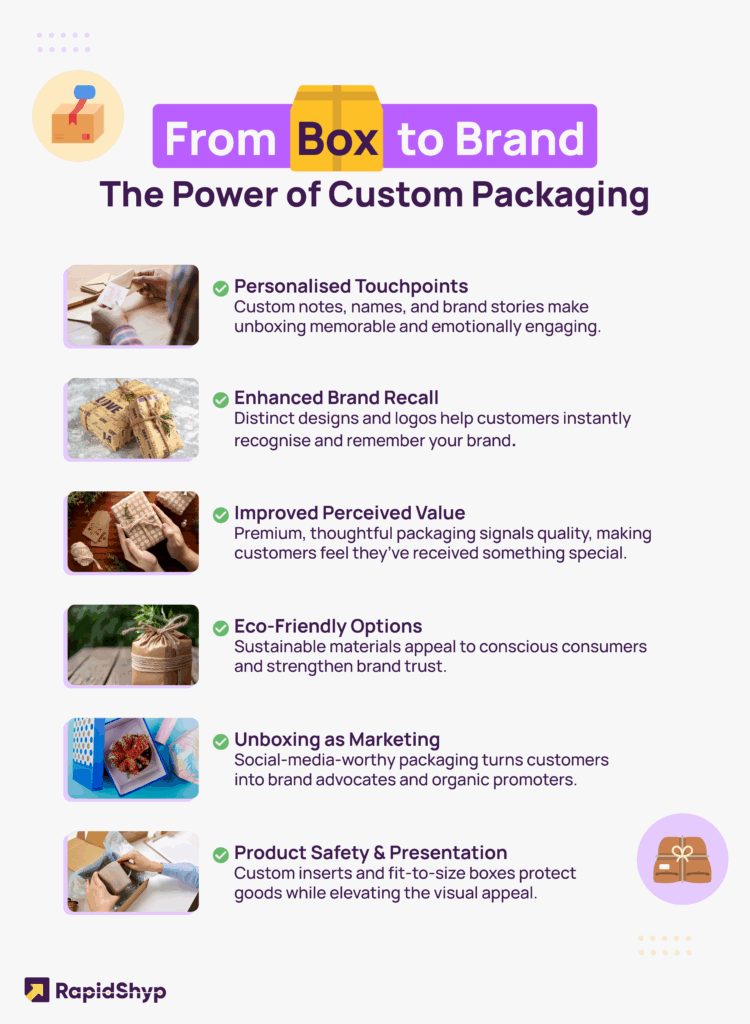
In a world where most customer interactions are digital, packaging is the first (and sometimes only) tactile brand moment. When that moment feels intentional, premium, and emotionally aligned with your brand promise, it creates instant recognition.
How Customised Packaging Reinforces Identity
- Consistent colours that trigger recall
- Logos and design elements that anchor familiarity
- A design language that matches your brand personality—playful, minimalistic, luxury, earth-friendly, quirky
A plain box is functional. A custom box is memorable.
And the numbers agree:
61% of consumers are more likely to repurchase when products come in premium packaging.
Not because of the product itself.
Because packaging shapes perceived value.
Every D2C founder competing for the same customer base should think of packaging as the most underpriced branding channel they own.
The Unboxing Effect: When Packaging Creates Emotion
Let’s be honest, people don’t unbox products anymore; they unbox expectations. The unboxing moment is where anticipation meets experience. It’s where trust is formed…or broken.
Customised packaging turns that moment into an emotional payoff.
What makes an unboxing memorable?
- A message that feels personal
- Inserts that guide the experience
- Crisp layering and thoughtful arrangement
- Use of textures, colours, and materials that feel premium
- A QR code that extends the story beyond the box
This isn’t decoration. It’s choreography.
And when unboxing feels like a story instead of a transaction, customers stay longer, share more, and return faster.
40% of customers share attractive packaging online. That’s free marketing. Organic reach. Social proof on autopilot.
Imagine turning customers into content creators without spending a rupee on influencer marketing.
That’s the power of custom packaging solutions.
Sustainability: The New Customer Currency
Today’s customers aren’t just curious about what’s inside the box; they’re equally curious about what happens to the box after. Sustainability has moved far beyond being a trend; it’s now a powerful purchase trigger. Studies show that 67% of consumers actively consider sustainable packaging before buying, and 74% are willing to pay more for eco-friendly options. This shift is why leading brands are embracing FSC-certified paper, plant-based inks, recyclable or reusable boxes, and low-ink minimalist designs. Because custom packaging isn’t just about aesthetics- it’s about values. When your packaging signals responsibility, customers trust you more, stay longer, and advocate louder. A sustainable box doesn’t just carry your product; it carries your brand ethics.
A sustainable box doesn’t just carry your product; it carries your brand ethics.
Read More: Eco-Friendly Packaging: Sustainable Packaging Ideas for 2026
The Operations Advantage: Packaging That Saves Money
We often think of packaging as branding, aesthetics, or customer experience. But behind the scenes, customised packaging is one of the most powerful operations and cost-optimisation levers a business can pull. Not because it looks good. Not because it photographs well. The right packaging design directly impacts logistics efficiency, shipping costs, return rates, and warehouse productivity.
Reduced Shipping Costs Through Right-Sizing
Carriers charge based on dimensional weight- the space your shipment occupies- not just how heavy it is. That means every extra inch of air inside your box is an extra rupee spent.
Oversized generic boxes often look convenient, but they inflate your shipping bill, require more filler material, and consume more warehouse storage than necessary.
Customised, right-sized packaging solves all of this.
When your packaging matches your product dimensions precisely, you reduce unnecessary space, eliminate wasted filler, and fit more inventory in the same storage area. The result?
Lower DIM charges, lower courier fees, and lower overall logistics costs. Most brands see a 20–30% reduction in shipping costs simply by switching to optimised packaging. And unlike marketing or discounts, these savings compound with every order you ship.
Fewer Damaged Orders and Lower Returns
A major hidden cost in eCommerce is breakage- products arriving dented, cracked, crushed, or leaking. Most of these damages don’t happen during transit; they happen because the product was not properly secured inside the box. Generic packaging forces you to rely too much on bubble wrap or paper fillers, which still leave room for movement.
Custom packaging changes this completely. Snug-fit inserts, tailored structures, and secure compartments ensure that products stay immobilised even during rough handling. This reduces breakages significantly, which means fewer refunds, fewer replacements, fewer reverse logistics costs, and far fewer customer complaints.
Faster Fulfilment & Smoother Warehouse Operations
Every uneven, ill-fitting, difficult-to-fold box slows down your warehouse. Every time a packer searches for the right-sized box, struggles with assembly, or overuses filler, you lose time, accuracy, and labour efficiency.
Custom packaging solves these challenges by bringing structure into the system. When your boxes are pre-structured, uniform, SKU-specific, and easy to assemble, the packing process becomes almost automatic. Warehouse teams work faster, dispatch becomes smoother, and picking and packing errors reduce. And your WMS becomes more accurate because everything fits predictably.
Ultimately, customised packaging isn’t just a box- it’s a logistics strategy disguised as branding.
Designing Custom Packaging: A Step-by-Step Approach
Many brands rush straight into printing patterns and colours, but great custom packaging doesn’t start with design; it starts with clarity. The most successful packaging is built through a structured journey that aligns creativity with functionality, logistics, and long-term ROI.
The first stage is understanding your needs. Before choosing colours or materials, you need to define the fundamentals: What exactly are you shipping? How fragile is it? Who is the end customer? What emotions or story should the packaging communicate? And of course, what budget are you working with? Packaging is a reflection of your brand’s aspirations, so the goal should always be long-term value, not short-term cost-cutting.
Once the foundation is clear, the next step is design and prototyping. This is where creativity meets practicality. Structural design ensures durability and ease of assembly, while graphic design shapes the emotional tone and visual identity. Material selection determines protection, sustainability, and overall feel. A prototype ties all these elements together, allowing you to test the real-world performance of your packaging before committing to bulk production. A simple drop test at this stage can save lakhs in future damages.
After the design is approved, the focus shifts to production and quality control. Consistency is everything here. Every batch must match in colour accuracy, print clarity, die-cut precision, and material strength. Your packaging should feel identical to customers every single time- that’s how brands build trust and reliability.
The next phase is fulfilment integration, where operational efficiency becomes the priority. Packaging should support your warehouse processes, not slow them down. This may involve training teams, updating SOPs, reorganising storage, or redesigning packing workflows. Even the most beautiful box becomes a liability if it delays fulfilment or complicates assembly.
Finally, measure and improve. Packaging isn’t a one-time project; it’s an evolving business asset. Track data such as damage rates, customer feedback, repeat purchase behaviour, and even UGC mentions to understand how customers perceive and interact with your packaging. Every insight helps refine your next batch and improves both experience and operations.
Custom packaging isn’t created in a day; it’s engineered through a thoughtful process that balances brand, emotion, and efficiency.
The Future: Smart, Personalised, Interactive Packaging
Packaging is no longer just about looking good- it’s becoming smart, responsive, and deeply personalised. Smart packaging adds a digital layer that turns every box into an experience: QR codes unlock tutorials or community pages, NFC tags verify authenticity, AR makes unboxing immersive, and traceability tools reduce support tickets before they even arise. A simple scan can extend customer engagement by almost ten times.
And then comes hyper-personalisation- the shift from “Dear Customer” to “Dear You.” With modern digital printing, even small batches can feature seasonal artwork, limited-edition drops, printed customer names, personalised thank-you notes, and targeted offers through unique QR codes. Personalisation isn’t just a trend anymore; it’s a competitive moat- one that strengthens loyalty, boosts repeat purchases, and makes customers feel undeniably seen.
Why Custom Packaging Is No Longer Optional
The market is crowded. Customer attention is shrinking and competition is exploding.
If your packaging blends in, your brand disappears.
Custom packaging solutions help you:
- Stand out
- Communicate value
- Deliver emotion
- Reduce costs
- Build loyalty
- Earn organic reach
- Improve operations
In eCommerce, packaging is the only channel that reaches 100% of your customers– no ad platform, no social media, no email can claim that.
So the real question is: Why would you not invest in it?
How RapidShyp Helps You Unlock Custom Packaging
Packaging is not just a protective layer- it’s a brand moment, a logistics tool, and a growth lever.
With RapidShyp, you can:
- Access custom printed packaging boxes tailored to your brand
- Order packaging materials with no minimum order requirement
- Choose from branded tapes, boxes, mailers, courier bags, and more
- Get packaging optimised for both B2B and D2C shipments
- Ensure right-sized packaging that reduces shipping costs
- Enjoy faster procurement with reliable vendor partnerships
Whether you’re scaling your D2C brand or optimising your eCommerce operations, RapidShyp helps you ship smarter, look better, and deliver memorable experiences, right from the packaging itself.
Frequently Asked Questions
1. Is custom packaging just a marketing expense?
Not at all. It reduces shipping costs, increases protection, and elevates customer experience, giving both operational and brand ROI.
2. Is it too expensive for small businesses?
Not anymore. Flexible MOQs and economical printing options make it accessible. Plus, the cost savings (DIM reduction, fewer returns, higher retention) often offset the investment.
3. Does it really impact customer experience?
Absolutely. Premium eCommerce packaging improves perceived value, unboxing satisfaction, and loyalty.
4. How does it reduce shipping costs?
By eliminating empty space, reducing package size, and cutting filler material.


Calculate Your Shipping Rates

| Courier Partner | Mode | Chargeable Weight (KG) | Shipping Rates |
|---|

