


Table of Contents
Most Shopify stores don’t fail because of bad products. They fail because of bad logistics. Late deliveries, scattered inventory, rising shipping costs, and operational overload quietly eat into profits. By the time most sellers realise what’s happening, fulfillment has already become the biggest bottleneck in their growth journey.
The truth is, launching a Shopify store has never been easier. You can set up your website, list products, and start accepting orders within hours. In fact, Shopify has rapidly become one of the most preferred eCommerce platforms in India. As of early 2026, Shopify holds roughly 20–21% market share among eCommerce websites in the country, powering more than 93,000 active merchants according to 2025 data.
But selling online is only half the job. The real challenge begins after a customer places an order.
Where will the inventory be stored? Who will pick and pack each order? How quickly will it be shipped? And what happens when orders start scaling faster than your operations?
Many Shopify sellers begin by managing everything themselves, packing boxes from their office, coordinating courier pickups, and tracking orders manually. It works in the early days. But as order volumes grow, so does the complexity of fulfillment.
What once felt manageable soon turns into a daily operational maze.
This is exactly why order fulfillment services for Shopify stores have become a critical part of modern eCommerce infrastructure. Instead of spending hours managing storage, packing, and shipping, businesses can outsource these operations to fulfillment partners who specialise in handling logistics at scale.
In this guide, we’ll break down how order fulfillment works for Shopify stores, the different options available to merchants, and how the right fulfillment strategy can help you deliver faster, reduce operational stress, and scale your eCommerce business with confidence.
What Are Order Fulfillment Services for Shopify Stores?
In simple terms, order fulfillment is everything that happens after a customer clicks “Buy Now.”
That includes:
- Storing your inventory
- Managing stock levels
- Picking products from the warehouse
- Packing them securely
- Shipping them to customers
- Handling returns if needed
Instead of managing all this yourself, fulfillment services allow you to outsource the operational heavy lifting.
For Shopify sellers, this usually means connecting your store with a fulfillment provider. Once integrated, the process becomes almost automatic. No spreadsheets or manual dispatch chaos, just smooth operations.
Why Fulfillment Becomes the Biggest Bottleneck for Shopify Stores
Most Shopify businesses begin with a simple setup. Inventory is limited, order volumes are manageable, and the entire fulfillment process can be handled by a small team. At this stage, manually packing and shipping orders feels efficient and cost-effective.
The challenge begins when growth kicks in. As marketing campaigns start performing well and order volumes increase, fulfillment operations become harder to manage. More orders require more storage space, additional packaging materials, and constant coordination with courier services. Inventory tracking also becomes more complicated, especially when products are stored in multiple locations.
Without a structured system in place, operational inefficiencies begin to appear. Orders may be delayed, shipping costs may increase due to poor warehouse placement, and customer inquiries about delivery timelines become more frequent. Over time, logistics starts consuming more time and attention than actual business growth.
This is why fulfillment is often considered the silent growth barrier for Shopify sellers. While marketing and sales generate revenue, inefficient logistics can slowly erode both profitability and customer satisfaction.
Understanding Shopify’s Native Fulfillment Options
Recognizing that logistics can become challenging for merchants, Shopify offers a few built-in tools to help sellers manage shipping and order processing. These options provide a useful starting point for small businesses that are still handling fulfillment internally.
The first option is Shopify Shipping, which allows merchants to purchase shipping labels directly from their Shopify dashboard. Sellers can access discounted courier rates, print labels instantly, and share tracking details with customers. The system also calculates shipping costs automatically during checkout, simplifying the order processing workflow.
While Shopify Shipping helps streamline basic dispatch operations, it still requires sellers to manage inventory storage, order packing, and courier coordination themselves. For businesses with limited daily orders, this setup can work well. However, as order volumes grow, managing these operations internally can become increasingly complex.
To address this challenge, Shopify introduced the Shopify Fulfillment Network (SFN). This system allows merchants to store inventory in Shopify-operated fulfillment centers, where orders are processed and shipped on their behalf. When a customer places an order, Shopify’s system automatically routes the request to the nearest fulfillment center, ensuring faster processing and delivery.
Although SFN offers greater operational support, its availability is currently limited in certain regions, and many businesses require more flexible fulfillment networks that can support broader geographic markets.
How Third-Party Order Fulfillment for Shopify Works
Third-party fulfillment providers act as dedicated logistics partners for Shopify businesses. Instead of managing warehousing, packing, and shipping independently, sellers can rely on these providers to handle the entire operational workflow.
The process usually begins with inventory storage. Sellers send their products to the fulfillment provider’s warehouse network, where items are stored in organized storage systems. These warehouses are equipped with inventory management technology that continuously tracks stock levels and ensures accurate product availability.
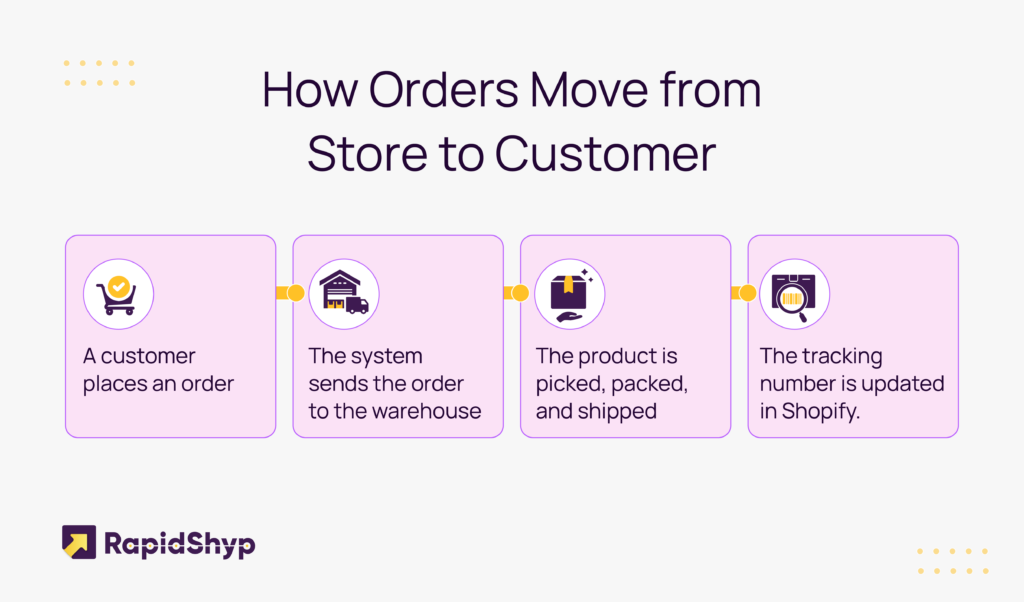
Once the Shopify store is integrated with the fulfillment platform, the order management process becomes automated. Whenever a customer places an order, the information is instantly transmitted to the warehouse. Warehouse staff then locate the product, pick it from storage, pack it securely, and prepare it for shipment.
The packaged order is then handed over to courier partners, and tracking details are automatically updated in the Shopify dashboard. Customers receive shipment updates in real time, which improves transparency and enhances the overall shopping experience.
Returns, which are a common part of eCommerce operations, can also be managed through fulfillment providers. Returned items are received at the warehouse, inspected for quality, and either restocked or processed according to the seller’s policies.
Why Location Matters in Fulfillment
One of the most important factors influencing delivery speed and shipping costs is the physical distance between the warehouse and the customer. If products are stored far away from major customer clusters, deliveries take longer and shipping expenses increase.
Modern fulfillment strategies solve this problem by distributing inventory across multiple warehouse locations. By storing products closer to customers, businesses can significantly reduce transit times and lower shipping costs.
For Shopify sellers, this approach makes a noticeable difference. Orders that might normally take four to five days to reach customers can often be delivered within one or two days when inventory is strategically positioned.
Faster delivery times not only improve customer satisfaction but also increase the likelihood of repeat purchases, which is critical for long-term eCommerce success.
Why Many Shopify Stores Outsource Fulfillment
Building a fully functional fulfillment infrastructure internally requires significant investment. Businesses must secure warehouse space, purchase storage systems, hire operational staff, and implement inventory management software. Coordinating multiple courier services and managing daily dispatch operations also adds to the complexity.
For many Shopify sellers, these operational requirements quickly become overwhelming. Instead of focusing on business growth, founders find themselves spending most of their time managing logistics.
Outsourcing fulfillment allows businesses to avoid these infrastructure investments while still benefiting from professional logistics capabilities. By partnering with a fulfillment provider, Shopify sellers can access warehouse networks, technology platforms, and courier integrations without building these systems from scratch.
This shift allows businesses to redirect their energy toward activities that drive growth, such as marketing, branding, and product innovation.
A Smarter Way to Handle Shopify Fulfillment
As Shopify stores scale, logistics must evolve alongside the business. Efficient fulfillment is no longer just about shipping products, it becomes a strategic advantage that directly impacts delivery speed, operational efficiency, and customer satisfaction.
This is where technology-driven fulfillment networks come into play. Platforms such as RapidShyp Fulfillment are designed to simplify logistics for modern eCommerce sellers by combining warehousing, inventory management, and shipping operations into a single integrated ecosystem.
By connecting a Shopify store with a fulfillment platform like RapidShyp, sellers can store inventory across a PAN-India network of warehouses. Orders placed on the Shopify store are automatically routed to the nearest fulfillment center, where they are picked, packed, and shipped without manual intervention.
Storing products closer to customers enables significantly faster deliveries while also reducing shipping costs. In many cases, this approach allows Shopify sellers to offer one-day or two-day delivery timelines while maintaining better control over logistics performance.
Final Thoughts
Running a successful Shopify store requires more than great products and effective marketing campaigns. Behind every smooth customer experience lies a strong operational system that ensures orders are processed quickly and delivered reliably.
As order volumes increase, managing fulfillment internally becomes increasingly challenging. This is why many growing businesses turn to professional order fulfillment services for Shopify stores to streamline their logistics operations.
With the right fulfillment partner in place, Shopify sellers can reduce operational stress, improve delivery performance, and focus on scaling their business with confidence. And in a world where customer expectations are constantly rising, efficient fulfillment is often the difference between a store that struggles to keep up and one that truly thrives.


Calculate Your Shipping Rates

| Courier Partner | Mode | Chargeable Weight (KG) | Shipping Rates |
|---|


