

Table of Contents
While selling online, sending products to the buyer is a real task; speed is the differentiating factor. Reliability is remembered. And, when it comes to delivery failures, they linger far longer than a discount ever will!
For most online brands, shipping is no longer a backend operation. It is part of the customer experience, part of brand trust, and increasingly, part of conversion strategy. Yet, despite how critical delivery outcomes are, courier selection- one of the most impactful decisions in eCommerce shipping- is still handled manually or through static rules by many sellers.
This is where AI courier allocation changes the game.
As order volumes grow, delivery pin codes diversify, and customer expectations harden around next-day or predictable delivery, relying on instinct or fixed courier preferences becomes risky. What worked last month may fail today. What performs well in one region may struggle just two districts away. And what looks cheaper on paper can quietly inflate RTOs and customer complaints.
AI courier allocation brings intelligence, adaptability, and learning into courier decision-making. It replaces guesswork with probability, and habit with data. To understand why this matters so much for modern eCommerce, we need to start with the problem it solves.
The Hidden Cost of Manual Courier Selection in eCommerce Shipping
Courier allocation has traditionally been a human decision. Sellers either pick one “trusted” courier for most orders or switch between two or three partners based on cost slabs, zones, or basic COD rules. While this approach might feel controlled, it breaks down quickly at scale.
Manual allocation consumes time that businesses don’t realise they’re losing. Operations teams spend hours reviewing orders, switching couriers for certain locations, or correcting allocation errors post-dispatch. As order volumes increase, these micro-decisions turn into a daily operational bottleneck.
More importantly, manual systems fail to account for variability. Courier performance is not static. A courier that delivers well in Bengaluru may struggle in Tier 2 cities. A partner that performs strongly during non-sale periods may choke during festive peaks. Hub congestion, rider availability, weather disruptions, and local demand patterns constantly influence outcomes. Static courier rules cannot keep up with this level of complexity.
There is also the illusion of cost savings. Sellers often select couriers based on negotiated rates alone, assuming the cheapest option equals the most profitable one. In reality, a slightly cheaper courier with lower delivery success can increase returns, inflate RTO costs, and damage customer trust. These losses don’t always show up immediately, but they compound silently over time.
The biggest risk, however, is inconsistency. Inconsistent delivery experiences frustrate customers, increase support tickets, and weaken brand loyalty. In a market as competitive as Indian eCommerce, that inconsistency can push customers straight to a competitor.
This growing gap between delivery expectations and outdated allocation methods is exactly why AI in logistics has become essential rather than optional.
What Is AI Courier Allocation?
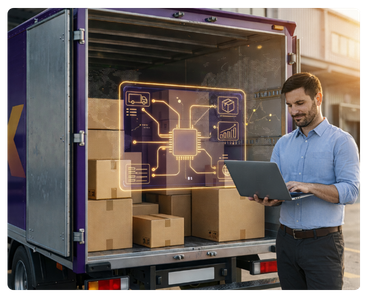
AI courier allocation uses artificial intelligence and machine learning to automatically select the best courier for each shipment. Instead of relying on fixed rules or human intuition, the system evaluates a wide range of variables in real time and recommends the courier most likely to deliver successfully for that specific order.
In simple terms, it answers a complex question instantly: Which courier should handle this shipment right now, for this pin code, product type, payment mode, and delivery expectation?
What makes AI courier allocation powerful is not just automation, but intelligence. The system does not treat all orders the same. A prepaid fashion order to a metro pin code is evaluated differently from a COD electronics shipment to a semi-urban region. Each decision is contextual, data-backed, and probability-driven.
At its core, AI courier allocation brings personalisation to eCommerce shipping, not for customers, but for logistics decisions.
How AI Courier Allocation Actually Works Behind the Scenes
AI in logistics thrives on data, and courier allocation is no exception. Every shipment generates data: delivery success, delays, return reasons, hub performance, transit time, and cost impact. AI courier allocation engines absorb this information and turn it into actionable intelligence.
The process begins with historical data. Past shipment outcomes across regions, seasons, product categories, and couriers are analysed to understand performance patterns. Over time, the system learns which courier performs best for specific combinations of variables.
But AI courier allocation doesn’t stop at history. It continuously incorporates real-time network signals. If a courier’s hub is congested today, if delays are spiking in a particular zone, or if load pressure is increasing during a sale period, the system adapts instantly. This dynamic decision-making is something manual systems simply cannot replicate.
Once an order is placed, the AI engine evaluates it against thousands of similar past shipments. It considers factors such as origin and destination pin codes, payment type, product weight, delivery urgency, and current network conditions. Based on this analysis, it assigns or recommends the courier with the highest probability of successful, timely delivery.
Crucially, the system keeps learning. Every completed delivery, successful or failed, feeds back into the model, making future decisions sharper and more accurate. Over time, courier allocation becomes not just automated, but predictive.
This is the foundation on which smart courier allocation platforms are built, and it’s exactly where RapidShyp Ayumi Select stands out.
Why AI Courier Allocation Matters More Than Ever for eCommerce
The Indian eCommerce ecosystem has matured rapidly. Customers now expect faster deliveries, transparent tracking, and consistent experiences regardless of location. At the same time, logistics networks are under constant pressure from high volumes, flash sales, and regional demand spikes.
In this environment, courier selection is no longer a tactical choice; it is a strategic one.
AI courier allocation directly impacts conversion rates, customer satisfaction, and operational profitability. Faster and more reliable deliveries improve post-purchase experience, increasing the likelihood of repeat orders. Smarter allocation reduces RTOs, which are one of the biggest silent killers of margins in Indian eCommerce shipping. Lower RTOs mean fewer reverse logistics costs, less blocked inventory, and healthier cash flow.
From an operations perspective, AI-driven allocation removes manual dependencies. Teams no longer need to intervene in day-to-day courier decisions, freeing them to focus on scaling the business rather than firefighting logistics issues.
Perhaps most importantly, AI in logistics brings clarity. Instead of wondering whether a courier choice was right or wrong, sellers can see delivery probabilities, success scores, and performance trends. Decision-making becomes transparent, measurable, and defensible.
Introducing RapidShyp Ayumi Select: AI That Thinks Like a Logistics Expert
RapidShyp Ayumi Select is built on the belief that courier allocation should be driven by intelligence, not instinct. It is designed to function like a seasoned logistics expert, one who remembers every past shipment, understands regional nuances, and reacts instantly to network changes.
At the heart of Ayumi Select is a smart courier recommendation. For every shipment, the system automatically selects the best courier using data-driven intelligence rather than static rules or human bias. Sellers don’t have to guess which courier might work; they are presented with the most reliable option for that specific order.
What truly differentiates Ayumi Select is its Pre-Dispatch Success Score. Every courier recommendation comes with a delivery-probability rating, giving sellers clear visibility into how likely a shipment is to be delivered successfully. This shifts courier selection from blind trust to informed confidence.
Ayumi Select also continuously factors in real-time network signals. Delays, load surges, and hub congestion are not afterthoughts; they are core inputs into allocation decisions. If conditions change, so does the recommendation. This dynamic adaptability is critical during sales, festive seasons, or unexpected disruptions.
Equally important is the system’s ability to learn from reliability and speed history. Ayumi Select doesn’t just look at averages; it learns from past outcomes across regions, time periods, and delivery scenarios. Over time, its recommendations become sharper, more contextual, and more accurate.
The result is a courier allocation that evolves with your business and the logistics ecosystem around it.
AI Courier Allocation as a Competitive Advantage
Brands often compete on pricing, product variety, or marketing. Logistics, however, is increasingly becoming the differentiator that customers remember.
AI courier allocation allows businesses to deliver consistency at scale. It ensures that as order volumes grow and geographies expand, delivery quality does not degrade. This consistency builds trust, reduces friction, and strengthens brand perception.
For growing sellers, especially those expanding into new regions, AI-driven allocation removes uncertainty. They don’t need prior experience in every pin code; the system already understands what works where. This lowers the risk of expansion and accelerates growth.
From a financial standpoint, smarter courier allocation optimises shipping costs without compromising delivery success. Instead of chasing the cheapest rate, sellers achieve the best outcome-cost balance, something only AI in logistics can continuously optimise.
The Future of eCommerce Shipping Is Predictive, Not Reactive
The evolution of logistics is moving from reaction to prediction. The future is not about fixing delivery failures after they happen, but preventing them before dispatch.
AI courier allocation represents this shift. By predicting delivery success, adapting to network conditions, and learning continuously, it transforms eCommerce shipping from a cost centre into a strategic advantage.
Platforms like RapidShyp Ayumi Select are not just tools; they are decision engines. They bring intelligence to every shipment, ensuring each order has the highest possible chance of success as soon as it leaves the warehouse.
In a world where customer patience is shrinking and competition is relentless, relying on instinct is no longer enough. Data-driven logistics is not the future; it is the present.
For eCommerce businesses looking to scale sustainably, AI courier allocation is no longer optional. It is essential.


Calculate Your Shipping Rates

| Courier Partner | Mode | Chargeable Weight (KG) | Shipping Rates |
|---|


