

Table of Contents
Ten years ago, logistics was less complicated or at least it looked that way. You booked a truck, sent your goods, waited for a delivery update (if any), and hoped everything arrived on time. Fast forward to today, and the game has undergone a complete transformation.
The B2B logistics in India is now running on data, automation, and intelligence. It’s not just about moving goods anymore; it’s about moving information and decisions in real time.
According to industry reports, over 70% of logistics companies in India have already begun their digital journey. But transformation isn’t just about buying software. It’s about helping people, teams, and processes unlearn the old and adapt to the new. Because the real revolution isn’t in the code- it’s in the culture.
Let’s explore how the new age of B2B logistics digital transformation is unfolding in India and what sellers, manufacturers, and distributors can learn from it.
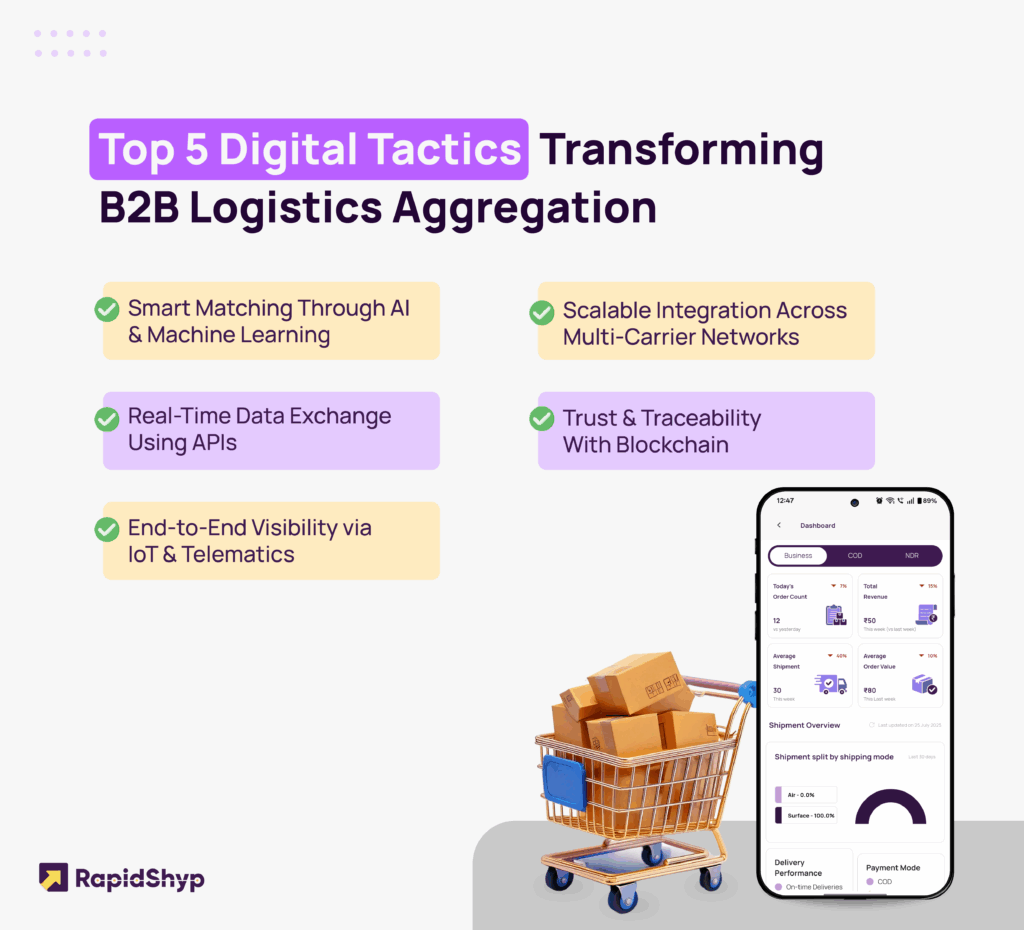
1. Smart Matching Through AI & Machine Learning
AI and ML aren’t just buzzwords anymore. They’re quietly shaping how shipments move across India.
Think of how Delhivery or Bluedart optimise thousands of deliveries daily. Behind the scenes, AI is analysing data like traffic, delivery histories, weather forecasts, and even regional festivals to match the right shipment to the right carrier.
A Bengaluru-based logistics aggregator recently reduced idle fleet time by 22% using machine learning models that predicted shipment volumes and helped them allocate vehicles more efficiently.
For B2B logistics players, AI now means fewer delays, fewer empty miles, and better customer satisfaction, something that directly impacts bottom lines.
2. End-to-End Visibility via IoT & Telematics
Gone are the days when customers asked, “Mera shipment kahan hai?” and no one had a clear answer.
Today, IoT-enabled sensors and telematics are changing how businesses monitor goods in motion. For instance, Mother Dairy uses temperature sensors in its cold chain fleet to ensure milk and curd reach stores fresh. Similarly, PharmEasy relies on GPS-enabled tracking for medicine shipments that can’t afford temperature fluctuations.
With India’s Industrial IoT market expected to touch USD 28 billion by 2033, the message is clear: visibility isn’t a luxury anymore; it’s a competitive necessity.
Read More: Beyond Tracking: How Real-Time Visibility is Redefining B2B Shipping Efficiency
3. Real-Time Data Exchange Using APIs
Imagine you’re a seller shipping 500 parcels a day through five different courier partners. You can’t possibly log in to five dashboards every morning to track shipments. That’s where APIs (Application Programming Interfaces) change the game.
The Unified Logistics Interface Platform (ULIP) is one of India’s biggest tech leaps, integrating 43 systems across 11 ministries. It’s helping logistics players sync data, automate paperwork, and access real-time cargo status, all through APIs.
This means businesses can now auto-sync orders, generate labels, and track every parcel from one screen. No more calling couriers or juggling Excel sheets.
4. Trust & Traceability With Blockchain
Every business wants transparency, especially when multiple intermediaries handle the same shipment. Enter blockchain, the digital ledger that’s rewriting how trust is built in B2B logistics.
By recording every update on a shared, tamper-proof ledger, blockchain ensures that what’s shown on your dashboard is exactly what’s happening on the ground.
Some Indian ports are already testing blockchain for customs documentation, cutting down clearance time by almost 40%. For shippers, that means faster movement, fewer disputes, and a cleaner audit trail.
5. Scalable Integration Across Multi-Carrier Networks
Every growing business hits the same wall: scaling logistics efficiently. One carrier can’t always cover every pin code, nor can every courier handle every weight slab or priority type.
This is where cloud-based logistics platforms are changing the game. By integrating multiple carriers, they help sellers choose the best rates, routes, and reliability all in one dashboard.
For example, many D2C brands selling through Shopify, WooCommerce, or Amazon have started integrating with multi-carrier logistics aggregators. These platforms automatically assign the most suitable courier for each order based on real-time factors like price, delivery speed, location coverage, and past performance.
So instead of manually comparing rates or logging in to multiple courier dashboards, sellers can manage everything from a single interface, right from label generation to live tracking.
Any guesses about the outcome? Even small and mid-sized businesses can now ship as efficiently as large enterprises, achieving scale and reliability without having to invest in expensive logistics infrastructure or tech teams.
The Human Side of Digital Transformation
Technology is just half the story. The other half is people.
No software rollout, app integration, or system upgrade can succeed unless the people behind it are ready to adapt. In logistics, this transformation runs deep, from drivers who once relied on phone calls now tracking loads through mobile apps, to warehouse teams moving from manual checklists to digital inventory dashboards.
The shift isn’t just operational; it’s cultural.
Many logistics providers in India have realised that B2B logistics digital transformation isn’t a one-time project; it’s an ongoing mindset change. They’re investing in upskilling programs, running “digital bootcamps” for on-ground teams, and even rewarding employees who lead adoption efforts. Some celebrate internal “tech milestones,” the first 1,000 app-based deliveries or the first entirely paperless dispatch, to make innovation part of company culture.
This people-first approach is what sustains transformation. When teams feel empowered, not replaced, by technology, they don’t just use digital tools; they champion them. And that’s where true operational resilience begins.
India’s Logistics Momentum
India’s digital logistics wave is already reshaping how goods move and data flows across the country.
The results are visible:
12–18% reduction in transit times
10–20% improvement in on-time deliveries
1B+ API transactions under ULIP integration
150+ logistics startups collaborating with enterprise players
From D2C entrepreneurs in Jaipur to automotive suppliers in Pune, every player, big or small, is now plugging into digital ecosystems to compete smarter and deliver faster.
This digital shift isn’t confined to metros anymore; it’s democratising access to technology across India’s logistics network.
The Road Ahead: Smart, Scalable, Human
The future of logistics belongs to companies that can blend technology, data, and empathy.
AI, IoT, APIs, and blockchain are no longer optional upgrades; they form the digital backbone of modern supply chains. But the true differentiator will always be human, the people who use these technologies to simplify complexity, anticipate needs, and deliver with care.
The companies that master B2B logistics digital transformation will be the ones that don’t just digitise processes, but reimagine experiences for partners, customers, and teams alike.
Digital transformation isn’t about replacing people- it’s about reimagining how they work, connect, and lead. Because in the end, logistics may be powered by machines, but it runs on human intelligence.
How RapidShyp Fits In
Let’s be honest- B2B shipping in India has always felt like a puzzle. Multiple courier contracts, fluctuating rates, endless follow-ups, and no single source of truth. That’s exactly the chaos RapidShyp set out to simplify.
Think of it as your logistics control tower where multiple courier partners, bulk orders, and complex billing come together under one clean, intelligent dashboard. No more hopping between portals or calling customer care for tracking updates.
With 15+ courier integrations, real-time rate comparison, and smart automation, RapidShyp helps businesses find the best route, the best rate, and the best courier, automatically. Whether you’re shipping 50 packages or 5,000, the system scales with you.
For large distributors, that means higher delivery efficiency and lower costs. For smaller B2B sellers, it means access to enterprise-grade logistics, without enterprise-level headaches.
Because at RapidShyp, we’re not just digitising logistics, we’re humanising it. Making technology simple enough for every Indian business to use, and powerful enough for them to grow.


Calculate Your Shipping Rates

| Courier Partner | Mode | Chargeable Weight (KG) | Shipping Rates |
|---|


